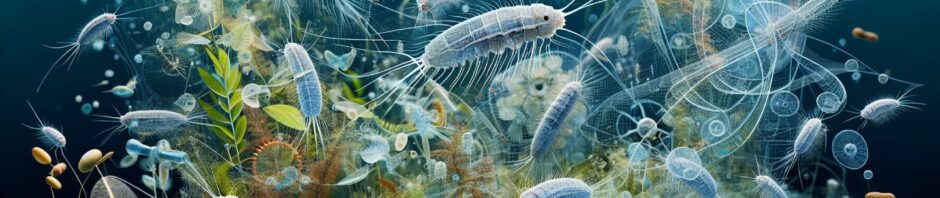
The intricate web of life beneath the water’s surface is a complexity many of us seldom appreciate. Among the multitude of tiny organisms that constitute aquatic ecosystems, one group of creatures stands out for their critical ecological roles and their use in scientific research: Daphnia. Commonly referred to as water fleas, these small freshwater crustaceans are more than just a food source for fish. They are bioindicators, research models, and key players in the health of our water-based environments. In this comprehensive article, we’ll delve into the life of Daphnia, underscoring its importance and role in maintaining ecological balance and its use in environmental monitoring and assessment.
What are Daphnia?
Daphnia are small planktonic crustaceans belonging to the order Cladocera. Measuring between 0.2 and 5 millimeters in length, they are almost invisible to the naked eye yet play a titanic role in their ecosystems. They inhabit a variety of freshwater environments from ponds to lakes and even temporary water bodies that arise after rainfall.
The Physiology and Life Cycle of Daphnia
These aquatic invertebrates have a distinct kidney-shaped or oval carapace that encloses most of their body, allowing for flexibility and protection. Daphnia move in a characteristic hopping manner through water, propelled by their large antennae. Within their transparent bodies, you can often observe the beating heart and developing embryos.
The life cycle of Daphnia can be quite fascinating. They exhibit a reproductive strategy known as parthenogenesis, where females produce offspring asexually under favorable conditions, leading to rapid population increases. When the environment becomes stressful, typically due to a decrease in food, overcrowding, or changes in temperature, Daphnia can switch to sexual reproduction. Males are produced, and mating leads to the formation of resistant eggs known as ephippia, which can withstand adverse conditions and hatch when the environment becomes favorable again.
Ecological Significance
Role in the Food Web
Daphnia occupy an essential niche in freshwater ecosystems. They are filter feeders, consuming algae, bacteria, and other small particles in the water. By grazing on phytoplanken, they can control algal blooms and consequently influence the water’s clarity and quality. This feeding activity makes them primary consumers in aquatic food webs. Moreover, thanks to their abundance and nutritional content, Daphnia constitutes a significant food source for various predators, like fish and invertebrates, thus supporting higher trophic levels.
Nutrient Cycling and Water Quality
These organisms contribute to the cycling of nutrients such as nitrogen and phosphorus by breaking down organic matter into simpler forms that can be used by other organisms, like plants and bacteria. They also play a role in the cycling of oxygen by respiring and photosynthesizing, which can affect the levels of dissolved oxygen critical for other aquatic life.
Indicator Species and Biomonitoring
Perhaps one of the most notable roles of Daphnia is as a bioindicator. Their responses to various environmental changes make them exceptional tools for biomonitoring. Researchers assess populations of Daphnia to gauge the health of aquatic environments. Changes in their abundance, size, or behavior can indicate the presence of pollutants or shifts in water quality before more overt problems arise, such as fish deaths.
The Use of Daphnia in Environmental Research
Toxicity Testing and Ecotoxicology
In ecotoxicology, Daphnia serve as standard organisms for testing the toxicity of various compounds, including pesticides, heavy metals, and other pollutants. Their short life cycle and easy cultivation in the laboratory make them ideal for such studies. Acute and chronic toxicity tests measure the impact of substances on survival, growth, and reproduction in Daphnia, providing valuable data about potential environmental hazards.
Studying Climate Change Effects
Researchers use Daphnia as a model to understand the implications of climate change on aquatic organisms. For instance, they can study the effect of temperature on metabolic rates, life cycles, and feeding behaviors, which can indicate how climate change might alter the dynamics of aquatic ecosystems.
Behavioral Responses and Evolutionary Adaptations
The transparency of Daphnia allows for in-depth behavioral studies. Scientists can observe real-time responses to stimuli and track different physiological processes. Additionally, Daphnia exhibit interesting evolutionary adaptations to avoid predation, such as changes in body size, coloration, or the development of defensive structures. These adaptations provide valuable insights into predator-prey interactions and evolutionary processes.
Restoration and Management of Aquatic Environments
The importance of Daphnia extends to practical applications in the restoration and management of aquatic habitats. By analyzing Daphnia populations and their health, environmental professionals can make informed decisions regarding interventions needed to restore or maintain balanced aquatic ecosystems, combating problems like eutrophication and supporting biodiversity conservation efforts.
Conclusion
Tiny as they may be, Daphnia play an outsized role in the health and functioning of aquatic systems. As filter feeders, indicators of environmental health, subjects of toxicity testing, and tools for understanding ecological dynamics, Daphnia help to maintain the delicate balance of freshwater ecosystems. Their value as a model organism in aquatic research can’t be overstated, providing critical insights that benefit not only science but also the preservation and improvement of the environments we all rely on.
Sources
- Ebert, D. (2005). Ecology, Epidemiocrity, and Evolution of includes Daphnia. National Center for Biotechnology Information. https://www.ncbi.nlm.nih.gov/pmc/articles/PMC1256339/
- United States Environmental Protection Agency (EPA). (2020). Aquatic Life Ambient Water Quality Criteria for Ammonia – Freshwater 2013. https://www.epa.gov/wqc/aquatic-life-ambient-water-quality-criteria-ammonia-freshwater-2013
- Lampert, W. (1987). Laboratory studies on zooplankton-cyanobacteria interactions. New Zealand Journal of Marine and Freshwater Research, 21(3), 483–490. https://doi.org/10.1080/00288330.1987.9516233