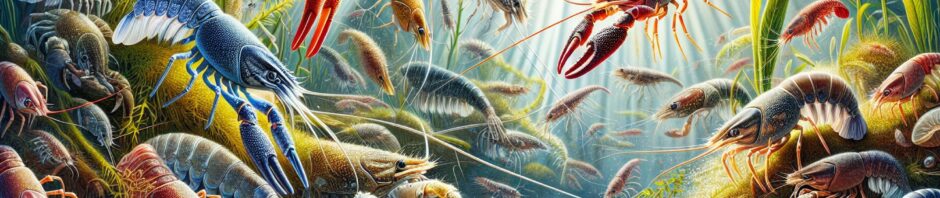
If you’re an aquarium enthusiast or a nature lover, you’re probably well-aware of the variety of colorful, exotic species curating the fascinating aquatic world. You’d likely be familiar with bright-colored fish, exotics marine corals, and turtles. However, the one group that often slips the spotlight is the humble, yet incredibly important: freshwater crustaceans.

Primarily known as Scavengers – crustaceans are like the “cleaners” of freshwater aquatic ecosystems. They work silently, mostly unseen and unappreciated, but their roles are undeniably pivotal. Here’s a journey into understanding these unsung heroes and appreciating their invaluable contribution to our water bodies.
Understanding Freshwater Crustaceans
Crustaceans are typically associated with marine environments, but a large number of crustacean species are actually freshwater inhabitants. This group is incredibly diverse, consisting of over 10,000 species, including shrimps, crabs, lobsters, crayfish, woodlice, and many others[^1^].
Whilst freshwater crustaceans vary greatly in shape and size, they share common attributes that characterize them. For instance, most of them have a hard exoskeleton – a tough outer shell that protects their soft interiors. They also have paired appendages, including legs for walking, pincers for feeding, and antennae for sensing their environment.
Although they might seem small and insignificant, these organisms play a crucial role in the aquatic food web dynamics.
Their Role in the Aquatic Ecosystem
Freshwater crustaceans are known for their variety of roles in aquatic ecosystems. They function as decomposers, breaking down dead organic material, and as predators, feeding on numerous invertebrates and assisting in nutrient cycling[^2^]. Plus, they serve as a nutrient-rich food source for a variety of species including fish, turtles, and birds.
Another crucial role they play is in contributing to the balance of the freshwater food web. Freshwater crustaceans function at several trophic levels within the food web – as primary consumers feeding on plant matter, secondary consumers predating on smaller invertebrates and themselves being a food resource for higher trophic levels. By working these various roles, they help maintain the ecological balance.
How They Survive – Adaptation & Reproduction
Freshwater crustaceans show distinct evolutionary adaptations that allow them to survive varying environmental conditions. One of the cool adaptation shown by crustaceans is the ability to adjust their body color to their surroundings, providing excellent camouflage against potential predators.
In terms of reproduction, freshwater crustaceans exhibit two principal modes – sexual reproduction and parthenogenesis. Sexual reproduction is common and allows for genetic diversity. Parthenogenesis, where females produce offspring from unfertilized eggs, allows for rapid population expansion and is often seen when environmental conditions are favorable[^3^].
The Impact of Human Activities
Regrettably, human activities often compromise the well-being of these essential freshwater custodians. Factors such as temperature effects from climate change, water pollution from chemical pollutants, and eutrophication from excessive nutrients often degrade their habitats, leading to reduction in their populations[^4^].
Freshwater crustaceans are widely recognised as key bio-indicators for water quality assessments due to their sensitivity to environmental changes. Therefore, their decline not only impacts the aquatic biodiversity but also means possible degradation of water quality.
You Can Make a Difference!
As conscious beings, it is important for us all to contribute towards the conservation of these species. Simple steps, like reducing water waste, minimizing the use of chemical cleaners and pesticides, can go a long way. After all, the survival of these species and, indeed, the health our ecosystems are inextricably linked to our actions.
To sum up, freshwater crustaceans are crucial members of the aquatic world, worth our understanding and protection. Their roles in maintaining ecological balance are irreplaceable and our efforts towards conserving them are undeniably essential.
[^1^]: Martin, J.W. and Davis, G.E., 2001. An updated classification of the recent Crustacea. No. 39. Natural History Museum of Los Angeles County.
[^2^]: Creed, R.P. and Reed, J.M., 2004. Ecosystem engineering by crayfish in a headwater stream community. Journal of the North American Benthological Society, 23(2), pp.224-236.
[^3^]: Martin, P., Kohlmann, K. and Scholtz, G., 2007. The parthenogenetic Marmorkrebs (marbled crayfish) produces genetically uniform offspring. Naturwissenschaften, 94(10), pp.843-846.
[^4^]: Zaman, S. and Chauhan, T., 2012. Comparative study on effects of chemical pollutants on Cladocera. Journal of Applied sciences, 12(3), pp.322-330.