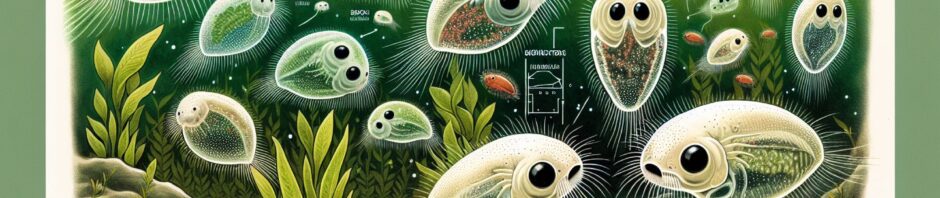
When it comes to the microscopic world of freshwater ecosystems, where tiny organisms play potentially massive roles, no creature is more intriguing than the Daphnia. These charming critters, otherwise known as the water fleas, offer a fascinating glimpse into the delicate balance of our lakes, ponds, and rivers.
Understanding the Daphnia
A member of the Cladocera order, Daphnia are small, planktonic crustaceans found in a variety of freshwater habitats across the world. A single Daphnia is roughly the size of a pinhead and has a translucent carapace which allows the viewing of its internal organs at work[^1^] — a live biology demo in action!
Daphnia primarily sustain themselves through filter-feeding, their tiny limbs constantly beating to create currents that draw in particles of algae and detritus. But this isn’t just about feeding themselves; Daphnia play a crucial role in nutrient cycling within their habitats, breaking down organic matter and converting it into forms more easily utilized by other organisms.
[^1^]: ‘Daphnia’ (2020) by Britannica. Available at: https://www.britannica.com/animal/Daphnia
More Than Just Tiny Shrimps – Daphnia as Bioindicators
But Daphnia isn’t just another constituent of the food web – their role as bioindicators is what truly sets them apart. The term ‘bioindicator’ refers to organisms that can provide data about the health of an ecosystem by reflecting its relative levels of pollution or other forms of disturbance[^2^].
Changes in environmental conditions — from shifts in temperature and dissolved oxygen levels to the presence of chemical pollutants — can affect Daphnia physiology and behavior. Their transparency then makes these alterations visible, even to a human observer’s naked eye. When these changes occur, it is like a red flag warning us of potential environmental problems.
And this isn’t just any kind of warning. Bioindicators, like Daphnia, can offer early signs of pollution, before other signs like algal blooms or temperature increases are evident. For instance, Daphnia are sensitive to heavy metals, and their mortality or abnormal behavior in response to these toxic substances can serve as early warnings of water pollution[^3^].
[^2^]: ‘Bioindicators for assessing ecological integrity of prairie wetlands’ (1995), by Galatowitsch et al. Available at: https://www.jstor.org/stable/1942045
[^3^]: ‘Assessment of heavy metals pollution in water using the Genus Daphnia’ (2011) by Devi et al. Available at: https://link.springer.com/article/10.1007%2Fs40011-011-0025-3
An Ecological Achievement: The Daphnia’s Biological Toolbox
Using their biological toolbox, Daphnia engages in some truly amazing survival strategies. For instance, under stressful conditions, they may resort to parthenogenesis, a form of asexual reproduction, to quickly boost population numbers. When conditions are right, Daphnia can switch back to sexual reproduction, producing ephippia (thick-shelled eggs) that can survive harsh conditions and lay dormant until conditions improve.
Further, Daphnia have evolved to react to predator presence with physical changes, such as growing protective spikes or helmets, or becoming larger or smaller depending on the type of predator. These ‘necks’ or ‘helmets’ help deter predation, demonstrating the influence of trophic interactions on the evolution of organisms like Daphnia.
A Final Word…
Our small water fleas are big players in the world of aquatic ecology, helping us understand environmental health and population dynamics. Let’s appreciate what Daphnia bring to our aquatic ecosystems and continue to study them to protect those ecosystems for future generations. And remember – by helping the tiny Daphnia thrive, we’re effectively helping to sustain the health of our big, blue planet.
I hope you’ve enjoyed getting to know our tiny ecological heroes and the intricate roles they play in our freshwater ecosystems. Next time you spot a body of fresh water, think of the bustling life of Daphnia down in its depths, acting as a critical part of the food web, recycling nutrients, responding to environmental changes, and acting as our heralds of aquatic health.