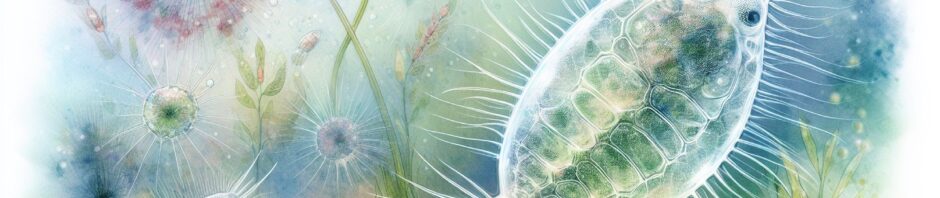
Daphnia, also known as water fleas, are tiny freshwater crustaceans that exist virtually in every corner of the world. These little creatures play a pivotal role in the ecosystem with a far-reaching impact that extends much beyond their tiny size.

Daphnia are part of the group of animals known as Cladocera, and they come under the umbrella of zooplankton, which encompasses all the tiny organisms floating in the water column. But don’t let their minuscule size, typically measuring up to 5mm, fool you. What Daphnia lack in size, they make up in numbers and ecological importance.
Life Cycle and Reproduction
Understanding the life cycle, reproduction modes, and survival adaptations of Daphnia provides an insight into their versatile nature and their critical role in the environmental aspect.
Daphnia have a fascinating life cycle that includes both asexual reproduction (parthenogenesis) and sexual reproduction[^1^]. During favorable conditions, female Daphnia produce clones of themselves without the need for males. However, when environmental conditions worsen, Daphnia females produce males, and sexual reproduction occurs, resulting in a tough and resting egg case known as an ephippium.
Food Web Dynamics and Population Dynamics
As primary consumers, these filter feeders ingest algae and bacteria performing an invaluable service of nutrient cycling within the aquatic ecosystems. Simultaneously, they serve as a crucial food source for various animals, like fish and insects, thereby efficiently linking the microscopic, autotrophic part of the ecosystem (algae) with the larger, heterotrophic part (fish).
Feeding on algae helps control algal blooms, reducing the risk of eutrophication, a phenomenon resulting in a dense plant growth decreasing the dissolved oxygen in water bodies, ultimately suffocating fish and other aquatic organisms[^2^].
The population dynamics of Daphnia are so sensitive that any shift can significantly impact the entire food web dynamics within the ecosystem.
Daphnia in Ecotoxicology and Biomonitoring
Beyond being a crucial link in the aquatic food chain, Daphnia also have an essential role in scientific research. They are model organisms used in the field of ecotoxicology for tracking water quality and evaluating the impact of various chemical pollutants on aquatic environments.
In an experimental setting, Daphnia are exposed to various concentrations of toxins or pollutants. Their observed behavioral responses are used to assess the potential toxicity levels of these substances[^3^]. They are particularly useful for their sensitive responses to changes in water temperature and oxygen concentration, among other environmental conditions. This characteristic makes Daphnia great indicators of aquatic health and integral to numerous environmental assessment projects.
Moreover, the evolutionary adaptations these tiny creatures exhibit make them invaluable resources for scientists studying climate change and pollution effects on aquatic life.
In Conclusion
Daphnia may be small and seemingly insignificant, but their roles in ecosystem balance, nutrient cycling, and ecological research are substantial. From contributing significantly to food web dynamics, exhibiting intriguing modes of reproduction, to providing insights about water quality and environmental changes, Daphnia are indeed unassuming heroes of our aquatic ecosystems.
Next time you spot a body of fresh water, remember that an intriguing world of tiny creatures like Daphnia exists underneath–part of a complex interconnected web, carrying on diverse and crucial functions vital for the aquatic ecosystem at large.
[^1^]: National Geographic: Daphnia’s Double Life
[^2^]: OceanService.NOAA.gov: What is eutrophication?
[^3^]: Nature Education: Using Daphnia to Teach a Comprehensive Biology Course to Non-Major