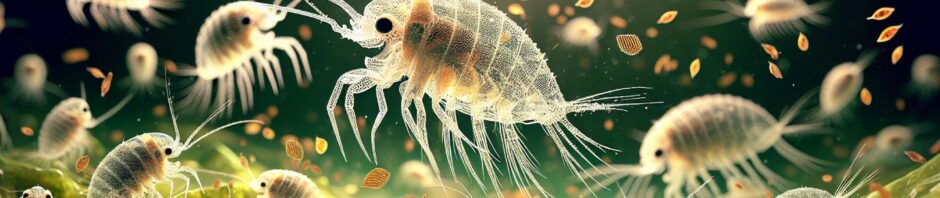
Welcome to our blog post on one of the most intriguing and essential creatures found in our freshwater ecosystems. Today, let’s dive beneath the surface and take a closer look at Daphnia, commonly known as water fleas.
Daphnia are small planktonic crustaceans that are part of the group known as Cladocera. These tiny invertebrates, despite their size, play a massive role in maintaining the health and balance of aquatic ecosystems worldwide[^1^].
Daphnia’s Role in Aquatic Ecosystems
One of the critical roles of Daphnia in aquatic ecosystems is their position in the food web. They are primary consumers, meaning they mainly feed on algae, thus controlling algal blooms and play a crucial role in preventing eutrophication – the excessive growth of algae and plants due to an overabundance of nutrients[^1^].
On the other side, Daphnia is a favorite food for fish and some insects, acting as a critical link between the primary producers (algae and plants) and the higher trophic levels. Due to their central position in the food web, any changes in the Daphnia population might drastically affect the entire ecosystem!
Life Cycle and Reproduction
One of the fascinating aspects about Daphnia is its reproductive strategy. Interestingly, most of the time, Daphnia reproduce asexually through a process known as parthenogenesis. Female Daphnia will produce clones of themselves without needing a male!
However, when the environment is harsh or food is scarce, Daphnia switches to sexual reproduction. The females produce special eggs that need to be fertilized by the males. These eggs, once fertilized, get enclosed in a protective structure known as an ephippium, allowing them to withstand adverse conditions[^2^].
Predicaments and Behavioral Responses
Like many other organisms, Daphnia is affected by a variety of environmental factors and threats, including predator-prey interactions, dissolved oxygen levels, temperature effects, and chemical pollutants.
For instance, Daphnia has evolved an extraordinary strategy to cope with predators. When sensing chemicals released by their predators, Daphnia might grow spines or crests – structures that make them less appealing or harder to catch[^3^].
Daphnia: Biomonitoring Champions
Due to their sensitivity to environmental changes and pollutants, Daphnia are often used as water quality indicators. In the field of ecotoxicology, these tiny animals are essential for evaluating the level of water pollution. Through toxicity testing, scientists can assess the impact of various substances on Daphnia and then extrapolate the possible effects on other organisms and overall water quality[^4^].
Conclusion
In essence, Daphnia may be little, but their impact is massive. These small creatures have a significant role in maintaining balanced ecosystems, serving as crucial water quality indicators, and helping scientists understand better our natural world. Protecting Daphnia and their habitats is indeed vital for preserving healthy freshwater ecosystems!
So, the next time you see a body of fresh water, remember there’s a high chance that beneath the surface, there are many tiny superheroes, like Daphnia, silently doing their part to keep our planet thriving!
For those who want to read more about Daphnia and their critical role in aquatic environments, I have linked to some scholarly articles and resources below.
[^1^]: Daphnia: Model herbivore, predator and prey. Polis, GA (1991). Available at Princeton University Press
[^2^]: The highs and lows of Daphnia reproduction. Mitchell, SE et al. (2004). Available at Cambridge University Press
[^3^]: Inducible defences in Daphnia. Kruppert, S et al. (2017). Available at The Royal Society Publishing
[^4^]: Daphnia as an emerging epigenetic model organism, Vandegehuchte MB et al. (2010). Available at Genetics Society of America