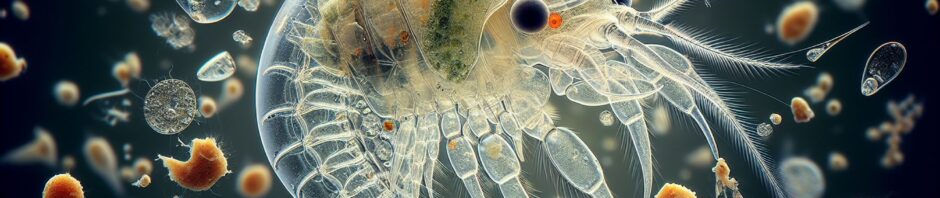

Meet Daphnia, often known as water fleas, that buzz around in freshwater environments like tiny aqua-drones. Although their name might indicate otherwise, these fascinating creatures are far from being fleas. They are actually small crustaceans, part of the large group of aquatic invertebrates that call our water bodies their home. In this article, we’ll uncover fascinating facts about Daphnia and explore their vital role in aquatic ecosystems.
Let’s start by setting the stage. Imagine you are looking into a droplet of pond water under a microscope, and there they are, the Daphnia, each one less than 3 millimeters long. Their bodies are quite intricate for their size, almost entirely transparent, which makes examining their internal organs a spectacle itself.
Here’s a fun fact: Daphnia’s heart beats at a staggering 180-300 beats per minute. And you can see this all in action through their transparent shell![^1^]
Life Cycle of Daphnia
One of the most unique features of Daphnia is their dual reproduction system. For most of the year, Daphnia populations consist entirely of females producing genetically identical daughters by a process called parthenogenesis. It’s only when environmental conditions take a turn for the worst—like the onset of winter or shortages of food—that the intriguing switch to sexual reproduction takes place. At this time, the Daphnia will begin to produce males, and the females will produce a different kind of egg that requires fertilization[^2^].
These fertilized eggs are sequestered within a protective casing called an ephippium and are capable of surviving harsh winter conditions or periods of drought. Once the conditions improve again, these eggs hatch to replenish the population[^2^].
Daphnia’s Role in Aquatic Ecosystems and Food Webs
Daphnia plays a critical role in freshwater food webs. They are primary consumers grazing on algae (including harmful algal blooms) and other microscopic particles, digesting them, and packaging them into bite-sized morsels for larger creatures. The waste they produce often contains less toxic, more nutrient-rich compounds that further aid the growth of other organisms and nutrient cycling in the system[^3^].
They also serve as one of the primary food sources for a vast number of higher-level consumers, from tiny insects to large fishes. Yes, those translucent little beings stave off hunger for a large number of predators, which places them at a critical crossroad in the food pyramid of aquatic ecosystems[^3^].
What’s really awe-inspiring is that Daphnia adaptively responds to the threat of predation. They’ve been found to grow larger spines and protective helmets when chemical cues in their environment suggest that predators are near[^4^]. Talk about having an evolutionary trick up their shells!
Daphnia and Water Quality Assessment
Apart from being an ecological linchpin, Daphnia serves yet another crucial function: they are living indicators of the water quality. They are highly sensitive to changes in water chemistry and overall ecosystem health. Changes in their populations can be an early warning sign of wider issues such as pollution, eutrophication, or declining water quality[^4^].
Scientists often use Daphnia in labs for toxicity tests to understand how different pollutants or chemicals would affect water bodies and their residents. It’s like having a canary in a coal mine, but for freshwater systems[^4^]. They are such a reliable indicator of water quality that many drinking water treatment plants use Daphnia to test their output[^5^].
To sum it up, Daphnia might be tiny, but their importance is enormous. They are essential for the functioning and equilibrium of aquatic ecosystems, serving as a food source for numerous organisms, aiding in nutrient cycling, and acting as water quality indicators. Next time you spot a freshwater pond or lake, take a moment to appreciate the bustling activity of these miniature powerhouses of the aquatic world.
And remember, you can watch their hearts beat under a simple microscope! Find Daphnia next time you’re near a pond and marvel at the tiny, transparent creature that’s so very vital to our planet.
References:
[^1^]: Arizona State University School of Life Science
[^2^]: Encyclopedia Britannica Entry on Daphnia
[^3^]: DeMott WR, Pape BJ. Stoichiometry in an ecological context: testing for a link between Daphnia P-content and poor food quality. Oecologia. 2005;142(1):20-27.
[^4^]: Weiss LC, Kruppert S, Laforsch C, Tollrian R. Morphological plasticity in response to predation risk is temperature dependent. Ecology and Evolution. 2015;5(16):3401-3411.
[^5^]: Gretchen H. Biesterfeldt, Adriana K. A. Landázuri, Sarah H. Swaren and Edmund E. Brodie. An acute sensitivity test using Daphnia in final stage municipal drinking water treatment. Water Research. 1996;30(11):2639-2642.