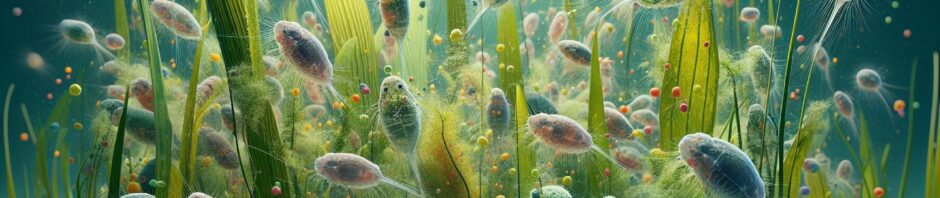
Do you know who the real superheroes of our freshwater ecosystems are? If your answer is “daphnia,” you’re absolutely right! Often referred to as “Water Fleas,” these intriguing organisms are some of the smallest yet most vital members of the aquatic community.
Daphnia (commonly called water fleas) are freshwater crustaceans belonging to the family Daphniidae, class Branchiopoda, and order Cladocera[^1^]. They are fascinating creatures with a vital role in freshwater ecosystems, where they serve as food for fish and other aquatic predators. They are also bioindicators for assessing water quality.
Anatomy: What Does Daphnia Look Like?
Daphnia, despite their nickname “water flea,” isn’t flea at all. They are, in fact, small (usually 0.2-3mm long), typically translucent crustaceans with a simple, yet distinctive anatomy[^2^]. Their bodies are enclosed within a single, transparent carapace shell, allowing viewers to see their beating heart and food-filled gut. They possess two large, antler-like antennae that they use for movement and sensing their environment.
Their most distinctive feature is probably their compound eyes, which help them detect light and stay away from predators.
Population Dynamics: How Do Daphnia Reproduce?
Whether it’s human society or a micro-organism community, survival is the one thing that matters most. Daphnia are exceptionally adaptable when it comes to maintaining their population. They reproduce through a process known as parthenogenesis, where females produce offspring without needing to mate.
During favorable environmental conditions, typically during spring and early summer, female daphnia reproduce asexually, giving birth to identical female progeny[^3^]. This capability allows a rapid increase in population size when resources are abundant.
Sexual reproduction happens when resources become scarce or environmental conditions become unfavorable. The females then produce males and sexual eggs (which are not immediately hatched), encapsulated within a protective casing called the ephippium[^3^]. These eggs can resist harsh environmental conditions and hatch when conditions become favorable again, continuing the cycle of life.
Role in the Ecosystem: What Do Daphnia Do?
Daphnia play a multi-faceted role in the function and balance of their ecosystems.
1. Food Source: As zooplankton, daphnia are essential parts of the food chain in their ecosystems, serving as an essential dietary component for a variety of fish and other aquatic invertebrates[^4^].
2. Algae Regulation: Daphnia are filter feeders, consuming algae and bacteria present in the water column, therefore helping control algal blooms and maintaining water clarity.
3. Biomonitoring Agents: Daphnia’s sensitivity to contaminants or changes in water quality makes them effective biomonitoring agents. They are routinely used in toxicity testing as their responses help detect the presence of harmful elements in water bodies[^5^].
Conservation of Daphnia: Why Should We Care?
Despite their tiny size and seeming insignificance, Daphnia play an irreplaceable role in our freshwater bodies’ health. Protecting these little “water fleas” ultimately means protecting both our waters and the larger animals (including us!) that rely on those waters for survival. As they reveal changes in water quality due to pollution or climate change, their survival directly indicates environmental health.
Conclusion
From maintaining water quality to serving as an essential link in the food chain, the mighty daphnia play an impressive role in sustaining our freshwater ecosystems, despite their tiny size. Their fascinating life strategies and adaptability give us a glimpse into the world of these invisible, yet vital organisms. So the next time you take a sip from your water bottle, remember these tiny titans thriving in the water bodies, quietly doing their part in keeping the world a healthier place.
[^1^]: Daphnia – an overview | ScienceDirect Topics
[^2^]: Introduction to the Cladocera
[^3^]: Parthenogenesis in Daphnia | The Embryo Project Encyclopedia
[^4^]: Role of zooplankton (Daphnia) in lake ecosystem
[^5^]: Daphnia as an Emerging Model for Toxicological Genomics