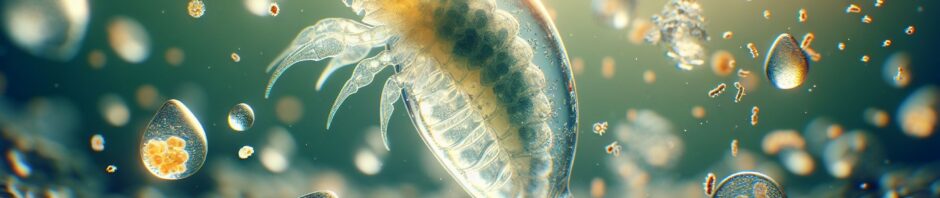
Ever wondered how a tiny creature can play an essential role in maintaining the balance of nature? Meet Daphnia, also known as water fleas. These small crustaceans, invisible to the human eye when floating in water, are one of nature’s most intriguing unsung heroes. This article aims to dig deep into the life and importance of Daphnia.
What is Daphnia?
Daphnia are tiny, translucent freshwater crustaceans, part of the large Cladocera family. Their nickname, “water flea,” arises from their similar movement to fleas, due to their jumping or twitching swimming pattern ^1^. Daphnia are a type of plankton — specifically, they fall under zooplankton, which includes many microscopic animals that drift in freshwater and ocean environments.
The Life Cycle of Daphnia
Something incredible about Daphnia is their reproductive strategy: they’re capable of both sexual and asexual reproduction (parthenogenesis) [^2^]. Typically, females produce eggs that develop without fertilization in warmer seasons, but, when environmental conditions worsen (like food scarcity or declining temperature), they switch to sexual reproduction. This process produces resilient, dormant eggs enclosed in a protective case called ephippia, which can survive harsh conditions until reactivation is possible.
Daphnia in the Food Web
In the food web dynamics of aquatic ecosystems, Daphnia serves as a crucial intermediary link. They’re filter feeders, sieving tiny particles of algae and other organic material from the water, thereby fueling their growth and reproduction. Their predation helps control algal blooms and can mitigate the effects of eutrophication, preventing water bodies from turning into dead, oxygen-depleted zones.
Fish, amphibians, and even other inverts are part of the list of animals that feast on Daphnia. They deliver essential nutrients up the food chain, showing just how integral these tiny creatures are to aquatic life’s greater trophic levels.
Daphnia as Biomonitoring Tool
Daphnia’s susceptibility to changes in water quality makes them ideal water quality indicators. In ecotoxicology, these little creatures are used for toxicity testing of freshwater environments, providing valuable insights for environmental assessment [^3^].
By evaluating the population dynamics, behavior responses, and even evolutionary adaptations of Daphnia, scientists gain significant understanding about dissolved oxygen levels, temperature effects, nutrient cycling, and the presence of chemical pollutants in the water. They’re often the first to react to environmental changes, providing early warnings of potential threats to an ecosystem’s health.
Conclusion
These delicate powerhouses, Daphnia, are living examples of the interconnections in our ecosystems. Their role is much more significant than just being “fish food.” They can be described as the unsung heroes of freshwater environments – playing roles in nutrient cycling, biomonitoring, demonstrating fascinating biological behaviors, and serving as a food source for other species.
So next time, when you look at a still pond or a slow-flushing stream, think about the mighty Daphnia, working tirelessly beneath the surface and contributing to the circle of life.
[^2^]: Reproduction in Daphnia
[^3^]: The Use of Daphnia to monitor water quality