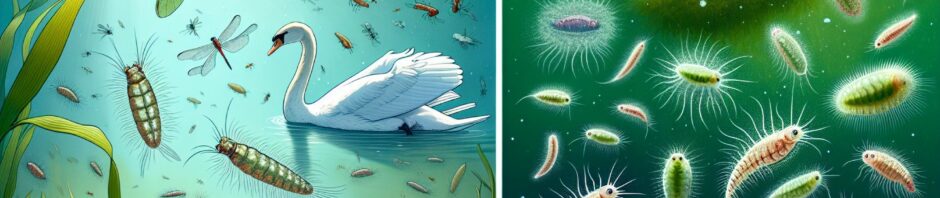
The intricate balance of freshwater ecosystems can often be attributed to the small yet significant residents of our lakes and ponds – Daphnia. More commonly known as water fleas, these minute crustaceans play a crucial role in maintaining the health and stability of their aquatic environments. This article will delve into the world of Daphnia, their life cycle, ecological importance, and how they serve as vital indicators of water quality and overall ecosystem health.
What is Daphnia?
Daphnia are small, planktonic crustaceans belonging to the order Cladocera. They inhabit a wide range of freshwater bodies, including ponds, lakes, streams, and even temporary water pools. These aquatic invertebrates are typically less than 5mm in size and possess a distinctive exoskeleton that encases their bodies, resulting in a transparent and often segmented appearance. Thanks to their jerky, hopping motion when swimming, they’ve earned the nickname “water fleas.”
Life Cycle and Reproduction
Daphnia exhibit a fascinating and adaptive life cycle that includes both asexual (parthenogenesis) and sexual reproduction. During favorable environmental conditions, typically in spring and summer, females reproduce asexually, producing genetically identical offspring and enabling rapid population growth to exploit abundant resources.
However, as food becomes scarce or environmental stresses increase, Daphnia switch to sexual reproduction. Males are produced, and mating occurs, resulting in the production of resistant eggs known as ephippia. These eggs are incredibly durable and can survive harsh conditions, including freezing and drying, only to hatch when conditions become favorable again.
Ecological Importance
Daphnia are filter feeders, meaning they play a vital role in aquatic food webs. They consume primarily algae, bacteria, and other microorganisms, acting as a bridge between primary producers and higher trophic levels, including many species of fish which prey on these tiny crustaceans.
The Balance of Algal Blooms
By feeding on algae, Daphnia help prevent excessive algal growth that could result in harmful algal blooms. These blooms are not only a threat to aquatic life due to their potential to deplete dissolved oxygen, but they can also release toxins that affect both wildlife and humans.
Nutrient Cycling and Water Clarity
Daphnia contribute to nutrient cycling within aquatic ecosystems. Their excretion provides essential nutrients like nitrogen and phosphorus, which are often limiting factors for the growth of aquatic plants and algae. Moreover, their filter feeding cleans the water, increasing clarity and aiding in photosynthesis for aquatic plants.
Daphnia as Bioindicators
One of the most crucial applications of Daphnia in environmental science is biomonitoring. Their sensitivity to various pollutants such as heavy metals, pesticides, and other chemical contaminants makes them excellent bioindicators for water quality.
Toxicity Testing and Ecotoxicology Studies
Daphnia are routinely used in toxicity testing due to their fast reproductive rates and easily observable responses to contaminants. Assessments examine the effects of pollutants on behavior, reproduction, survival, and other physiological processes. The outcomes of such tests are integral to ecotoxicology, informing policies and strategies for environmental protection.
Environmental Assessment Metrics
Daphnia populations provide valuable information through several metrics. Changes in their population dynamics, such as birth and death rates, can signal alterations in environmental conditions. Additionally, the presence or absence of specific Daphnia species can be an indicator of water quality, as different species have varying tolerances to pollutants.
Challenges to Daphnia Populations
While Daphnia are robust and adaptable, they face numerous challenges that threaten their populations and, by extension, aquatic ecosystem health.
Climate Change and Temperature Effects
Temperature plays a pivotal role in Daphnia’s metabolism and life cycle. Climate change-induced temperature shifts can cause stress to populations, affecting their survival and reproduction rates. It can also alter predator-prey interactions and food web dynamics, disrupting the balance within aquatic ecosystems.
Chemical Pollutants and Behavioral Responses
Chemical pollutants can induce a wide array of behavioral and physiological responses in Daphnia. These range from reduced feeding and altered swimming patterns to increased susceptibility to predation and diminished reproduction. Monitoring these responses is essential to understand and mitigate the impacts of pollution.
Eutrophication and Oxygen Levels
Excessive nutrient loads from agricultural runoff and urbanization can lead to eutrophication – nutrient-enriched waters that trigger excessive algae growth. As algae die and decompose, dissolved oxygen levels decrease, potentially creating dead zones where aquatic life cannot survive. Daphnia can help manage algae levels, but their own survival is jeopardized if oxygen becomes too scarce.
The Future of Research and Conservation
Ongoing research continues to uncover the evolutionary adaptations of Daphnia that allow them to cope with environmental stressors. Scientists are also interested in their role in predator-prey interactions and how these relationships shape aquatic ecosystems.
Conservation efforts for Daphnia and their habitats are crucial. Protecting these minute creatures is not an act of charity but a necessity for preserving the intricate web of life that contributes to the health of freshwater ecosystems. As more is learned about the significance of Daphnia, their conservation becomes ever more integral to maintaining the biodiversity and functionality of aquatic environments.
Conclusion
In conclusion, Daphnia may be small, but their impact on freshwater ecosystems is monumental. Understanding their life cycle, ecological importance, and status as water quality indicators is vital for environmental assessments and maintaining the health of aquatic ecosystems. As challenges such as climate change and chemical pollution continue to threaten these waters, placing greater emphasis on the conservation of Daphnia and their habitats becomes increasingly critical for the future of our planet’s freshwater resources.
Sources
- Ebert, D. (2005). Ecology, Epidemiology, and Evolution of Parasitism in Daphnia. National Center for Biotechnology Information, U.S. National Library of Medicine. https://www.ncbi.nlm.nih.gov/books/NBK2042/
- Lampert, W. (2011). Daphnia: Model Herbivore, Predator and Prey. Polskie Archiwum Hydrobiologii/Polish Archives of Hydrobiology. https://www.degruyter.com/document/doi/10.2478/v10104-011-0039-7/html
- Vanoverbeke, J. & De Meester, L. (2010). Cladoceran and copepod fauna are highly insensitive to a drastic change in temperature and conductance. Limnology and Oceanography, 55(5), 2253-2259. https://aslopubs.onlinelibrary.wiley.com/doi/10.4319/lo.2010.55.5.2253