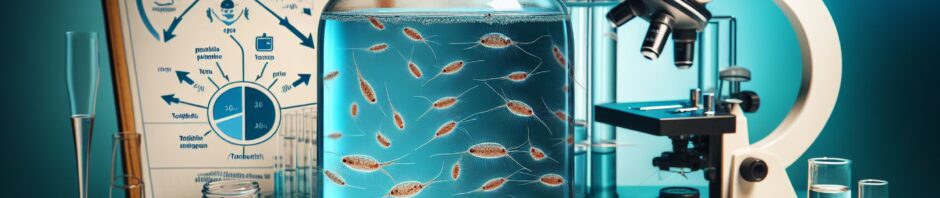
Water, one of Earth’s most crucial resources, is under continuous threat from human activities, pollution, and climate change. Ensuring its purity is essential not only for our survival but for maintaining the delicate balance of aquatic ecosystems. Among the several indicators of freshwater quality, one tiny organism stands out in scientific circles: Daphnia. These minuscule crustaceans may not be well-known outside of scientific communities, but they play an enormous role in understanding and preserving water quality and aquatic health. This article shall deep-dive into the world of Daphnia, exploring their biology, ecological importance, and their exceptional role in biomonitoring and ecotoxicology.
Daphnia: A Brief Introduction
Daphnia, also known as water fleas, are small planktonic crustaceans belonging to the class Cladocera. They inhabit diverse freshwater environments, from ponds to lakes and streams. These organisms range from 0.2 to 5 mm in size and have a distinct exoskeleton and a heart-shaped body, which is often transparent, letting us peer into their inner workings.
Life Cycle and Reproduction
Daphnia exhibit complex life cycles and reproductive strategies, such as parthenogenesis and sexual reproduction. During favorable conditions, females reproduce asexually, producing clones that are genetically identical to themselves. But when the environment becomes stressed, perhaps due to a change in seasons or food scarcity, they switch to sexual reproduction. This strategy produces dormant eggs encased within protective structures called ephippia. These eggs can resist harsh conditions and hatch once the environment becomes more habitable.
Role in Aquatic Ecosystems
In aquatic ecosystems, Daphnia are considered critical players. As filter feeders, they consume algae and organic debris, effectively clearing the water while also being a substantial food source for a variety of fish and other aquatic predators. Their population dynamics and health can tell us much about the ecosystem they occupy, including the impact of pollutants and other stressors.
Influence on Trophic Levels and Food Web Dynamics
Daphnia sit at an essential crossroads in food web dynamics. They help control the populations of primary producers (such as algae) while serving as a food source for secondary consumers, such as fish. This position places them at a critical trophic level within aquatic ecosystems, potentially influencing food web stability and nutrient cycling.
Daphnia in Biomonitoring
In the quest for methods to assess environmental health, scientists often turn to bioindicators – species or groups of species whose function, population, or status can reveal the qualitative status of the environment. Daphnia is prominent in this field and is used frequently in biomonitoring due to its responsiveness to shifts in water quality.
Water Quality Indicators
Daphnia’s sensitivity to changes in water quality makes them excellent living indicators. Their populations respond to a variety of factors, including:
- Nutrient Levels: An increase in nutrients can lead to algal blooms which affect Daphnia, both positively and negatively.
- Chemical Pollutants: Pesticides, heavy metals, and other toxins can cause Daphnia populations to decrease.
- Dissolved Oxygen: Daphnia require oxygen-rich environments. Low levels can be detrimental to their survival.
- Temperature: They are sensitive to extreme temperatures which can affect their metabolism and reproduction rates.
Ecotoxicology and Toxicity Testing
Due to their quick generational turnover and ease of assessment in laboratory conditions, Daphnia are widely used in ecotoxicology tests to evaluate the effects of various substances on living organisms within aquatic environments. Acute and chronic toxicity tests with Daphnia can yield invaluable data on the lethal and sublethal impacts of pollutants. Regulatory agencies utilize this data for environmental risk assessments and setting legal limits for different contaminants in water bodies.
Evolutionary Adaptations and Behavioral Responses
Over evolutionary timescales, Daphnia have developed intriguing adaptations to survive in fluctuating environments. Their ability to discern and react to chemical signals in the water – such as those released by predators – can prompt changes in their life cycle or behavior, a phenomenon which could be a pivotal factor in their long-term survival.
Predator-Prey Interactions
Daphnia exhibit fascinating predator-prey interactions. For instance, upon detection of certain chemicals released by predators, such as fish, they might develop defensive morphologies like helmets or spines, or alter their vertical migration patterns to avoid predation. Analyzing these interactions provides insight into evolutionary mechanisms and helps us understand how aquatic food webs might respond to environmental changes.
Population Dynamics and Environmental Assessment
The population dynamics of Daphnia serve as a useful tool for environmental assessment. Their populations can quickly respond to changes in the environment, making them suitable for rapid assessments. Moreover, their genetic diversity and rate of evolutionary adaptation can reveal how populations might cope with and potentially recover from environmental stressors.
Daphnia in the Face of Environmental Challenges
Daphnia face numerous environmental challenges, including algal blooms often caused by nutrient runoff leading to eutrophication, and the proliferation of toxic algae which can detrimentally affect their populations. Understanding how Daphnia respond to these challenges is crucial for maintaining water quality and the overall health of aquatic ecosystems.
Eutrophication and Algal Blooms
Eutrophication, a process where water bodies become overly enriched with nutrients (mainly nitrogen and phosphorus), can lead to explosive growth of algae, known as algal blooms. While a moderate increase in algae might seem beneficial for Daphnia populations, the subsequent depletion of dissolved oxygen due to decaying algae and the potential growth of toxic algal species can create a hostile environment for these organisms.
Nutrient Cycling and the Role of Daphnia
Daphnia are instrumental in nutrient cycling within aquatic ecosystems. By consuming algae, (Daphnia help regulate nutrient availability which in turn affects primary production. Moreover, their waste contributes to nutrient recycling, influencing the productivity and dynamics of the ecosystems they inhabit.
Conclusion
In the tapestry of life that constitutes our aquatic ecosystems, Daphnia might seem like tiny, insignificant threads. However, their impact is profound, both as a testament to the interconnectedness of life and as a practical tool for assessing and maintaining the health of our water bodies. Their biology offers a window into the dynamics of aquatic ecosystems and a means to gauge the integrity of our water resources.
Through their use in biomonitoring and toxicity testing, Daphnia help us understand the consequences of human actions on the environment and enable us to make informed decisions for water resource management. Recognizing and protecting such essential components of our ecosystems is key to preserving the quality of life on our planet for future generations.
References
- Lampert, W. (2011). Daphnia: Model Herbivore, Predator and Prey. Polish Journal of Ecology. 59, 599-610.
- Colbourne, J.K., Pfrender, M.E., Gilbert, D., Thomas, W.K., Tucker, A., Oakley, T.H., Tokishita, S