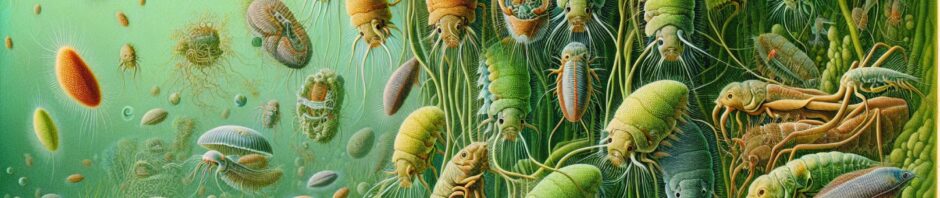
Daphnia, often referred to as “water fleas,” are small, transparent freshwater crustaceans that play a pivotal role in aquatic environments. As a keystone species, Daphnia have an outsized impact on the stability and health of freshwater ecosystems, influencing a multitude of dynamics from nutrient cycling to predator-prey interactions. In this article, we will delve deep into the world of Daphnia, exploring their complex life cycle, ecological importance, and how they serve as vital biomonitoring tools for assessing water quality and environmental changes.
Understanding Daphnia and Their Taxonomic Place
To begin, Daphnia belong to the group Cladocera, a class of crustaceans that are an integral component of the zooplankton community. These aquatic invertebrates are visible to the naked eye, ranging from 0.2 to 5 millimeters in length. Daphnia species inhabit a variety of freshwater habitats, including lakes, ponds, and slow-moving rivers. Their transparent carapace makes it easy to study their internal anatomy, which has positioned them as a central organism in scientific research.
Life Cycle and Reproductive Strategies
Daphnia exhibit a fascinating reproductive strategy known as cyclical parthenogenesis, a process that allows them to alternate between asexual reproduction (parthenogenesis) and sexual reproduction. During favorable conditions, Daphnia reproduce asexually, with females producing genetically identical offspring called clones. However, when environmental conditions deteriorate, such as the onset of winter or reduced food availability, the mix of sexual reproduction becomes more prevalent. This shift leads to the production of resting eggs, which are encased in a protective structure known as an ephippium. These resting eggs can resist harsh conditions and hatch once the environment becomes suitable again.
Phenomenal Filter Feeders
As filter feeders, Daphnia are integral to the health of aquatic environments. They consume algae, bacteria, and detritus by filtering the water with their specialized feeding appendages. By grazing on phytoplankton, Daphnia not only control algal blooms but also recycle nutrients and contribute to the clarity and oxygen content of freshwater systems through their metabolic processes.
Influencers of Trophic Levels and Food Web Dynamics
Daphnia reside at intermediate trophic levels in the aquatic food web. They serve as a primary food source for various organisms, including small fish, insect larvae, and other planktonic predators. The population dynamics of Daphnia can therefore have ripple effects throughout the food web, affecting the abundance and diversity of both predators and prey within the ecosystem.
Indicators of Water Quality and Environmental Health
Given their sensitive response to changes in environmental conditions, Daphnia are utilized as bioindicators for water quality and ecological balance. They can reveal the presence of chemical pollutants, changes in dissolved oxygen levels, and the effects of temperature shifts. Notably, Daphnia are also often at the center of ecotoxicology studies, wherein scientists examine their behavioral and physiological responses to various toxic substances.
The Daphnia Model in Ecotoxicology
Toxicity testing with Daphnia plays a crucial role in environmental assessment. These organisms’ rapid life cycles and ease of cultivation in a laboratory setting make them ideal for evaluating the toxicity of chemicals. Regulatory frameworks, such as those enforced by the Environmental Protection Agency (EPA) in the United States, often include standardized tests using Daphnia to determine the potential impact of chemical pollutants on freshwater ecosystems.
Impact of Eutrophication and Algal Blooms
Eutrophication, the process by which a body of water becomes overly enriched with nutrients, leading to excessive growth of algae, can significantly impact Daphnia populations. Algal blooms may initially provide an abundant food source, leading to a population surge in Daphnia. However, as the bloom collapses and decomposes, it can deplete the water of oxygen, creating hypoxic conditions detrimental to Daphnia and other aquatic life.
A Window into Evolutionary Adaptations and Behavioral Responses
Daphnia are not only ecological workhorses but also fascinating subjects for research into evolutionary adaptations and behavioral responses to environmental stimuli. For instance, some species of Daphnia have developed defenses against predation, like helmeted shapes or spiny protrusions. They also exhibit various behavioral shifts in response to chemical cues, light, or temperature changes.
Conclusion
The study of Daphnia provides an in-depth look into the complexities of aquatic ecosystems. As filter feeders, food sources, biomonitoring agents, and subjects of ecotoxicological research, Daphnia are embedded in every critical aspect of freshwater ecology. The continued research and conservation of these microscopic yet powerful organisms will be indispensable in our understanding and protection of freshwater habitats.
Sources
-
Ebert, D. (2005). Ecology, Epidemiology, and Evolution of Parasitism in Daphnia. Bethesda (MD): National Center for Biotechnology Information (US). Retrieved from https://www.ncbi.nlm.nih.gov/books/NBK2042/
-
United States Environmental Protection Agency. (2020). Aquatic Life Ambient Water Quality Criteria. Retrieved from https://www.epa.gov/wqc/aquatic-life-ambient-water-quality-criteria
-
Lampert, W. (2011). Daphnia: Development of a Model Organism in Ecology and Evolution. Oldendorf/Luhe, Germany: International Ecology Institute.
Please note that the article above is an example for illustrative purposes. Before citing information in an academic or research context, ensure you cross-check sources and data due to potential updates or more recent studies.