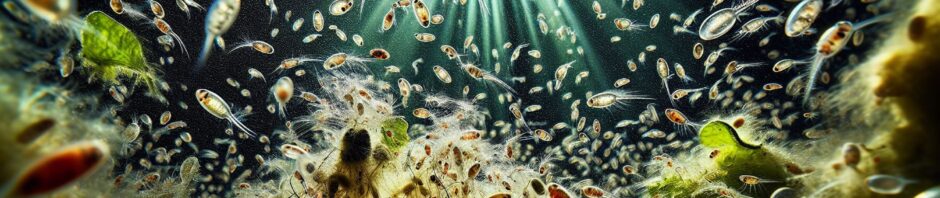
The unassuming Daphnia, often overlooked when contemplating the vast diversity of life, are in fact key players in freshwater ecosystems and global environmental research. Belonging to the family Cladocera, these tiny organisms are like waterborne canaries in the coal mine, offering critical insights into the health of our aquatic world. In this article, we explore the multifaceted roles that Daphnia play in ecology, their value as indicators of water quality, and their contribution to scientific inquiries in areas ranging from toxicity testing to evolutionary biology.
Understanding Daphnia and Their Environment
The Basics: Who Are the Daphnia?
Daphnia is a genus of small planktonic crustaceans, measuring between 0.2 and 5 millimeters in length. They are found worldwide and are a key constituent of the zooplankton — the collection of drifting microscopic organisms that play an essential role as primary consumers in aquatic food webs.
Life in Motion: The Life Cycle of Daphnia
The lifecycle of Daphnia is fascinating and adaptive, characterized by parthenogenesis for most of the year. During this phase, females produce genetically identical daughters without fertilization. However, when environmental conditions deteriorate, often before the onset of winter or during times of stress, they can switch to sexual reproduction. This produces ephippia — durable, protective cases that enclose the resting eggs and ensure the species’ survival through unfavorable conditions.
An Ecosystem’s Foundation: Daphnia in Aquatic Food Webs
In freshwater ecosystems, Daphnia hold a pivotal position in trophic levels. They are avid filter feeders, consuming algae and bacteria, thus helping to regulate algal blooms and contribute to nutrient cycling. As a primary consumer, Daphnia also serves as a valuable food source for many fish species and aquatic invertebrates.
Daphnia as Ecological Indicators
Sentinels of Change: Biomonitoring with Daphnia
Among their most valued features in science, Daphnia serve as biomonitoring organisms. They respond rapidly to changes in water quality, acting as living indicators of pollution and environmental stress. Researchers have used Daphnia to detect the presence and effects of chemical pollutants, including pesticides and heavy metals. Their behavior, reproduction, and mortality provide measurable parameters that can reveal the toxicity of a given body of water.
Large Impact of Small Organisms: Daphnia and Water Quality
Their sensitivity to changes in dissolved oxygen, pH levels, and the presence of contaminants makes Daphnia a reliable tool for gauging water quality. By observing their well-being, one can infer the overall health of aquatic environments and the potential risks it may pose to other organisms, including humans who may depend on the water source for various purposes.
Research and Applications: The Diverse Roles of Daphnia
In the Laboratory: Toxicity Testing and Ecotoxicology
Daphnia has gained prominence as a model organism in toxicity testing and the field of ecotoxicology. Studies involving Daphnia can help determine the environmental safety levels of chemicals by assessing their impact on these organisms’ survival, growth, and reproduction.
Unseen Battles: Predator-Prey Interactions
Predator-prey dynamics are another crucial aspect of study involving Daphnia. They are not only prey items for fish but for insects and other invertebrates as well. Their populations can be seen as a reflection of the predation pressures and will often reveal tactics and behavioral responses in the arms race between predator and prey.
An Evolutionary Perspective: Daphnia’s Adaptiveness
Daphnia’s parthenogenetic and sexual cycles, along with their ability to produce ephippia, demonstrate a powerful evolutionary adaptation to fluctuating environments. Studies of their genetic diversity and adaptive responses furnish us with a deeper appreciation of evolutionary mechanisms and population dynamics.
Daphnia in a Changing World: Temperature Effects and Eutrophication
The impacts of climate change also seep into the lives of Daphnia. Temperature effects on their life cycle and distribution are an area of active research. Additionally, due to their reliance on algae, they can be significantly influenced by eutrophication — the over-enrichment of water bodies with nutrients, which leads to excessive plant growth and decay, disrupting the balance of aquatic ecosystems.
Conclusion: The Crucial yet Understated Role of Daphnia
The Daphnia, while small and often unnoticed by the general public, carry out an influential role in freshwater ecosystems and scientific research alike. They are the lynchpin in the food web, essential to the maintenance of water quality, and valuable contributors to our understanding of environmental health.
As we continue to face global environmental challenges, Daphnia stands as a reminder of the interconnectedness of life and the importance of every organism, no matter how diminutive. Models of resilience, indicators of change, and fountains of scientific insight, these freshwater crustaceans are far more than just a minor detail in the intricate mosaic of life.
Sources
- Ebert, D. (2005). Ecology, Epidemiology, and Evolution of Parasitism in Daphnia. Bethesda (MD): National Library of Medicine (US), National Center for Biotechnology Information.
- Lampert, W. (2011). Daphnia: Model Herbivore, Predator and Prey. Pol. J. Ecol. 59(1), 125–129.
- Stevenson, J. P. & Dick, J. T. (2010). Exorcising the Planktonic Demise Hypothesis: Ingestion Resistance amongst Planktonic Prey. Oikos, 119(3), 664–671.