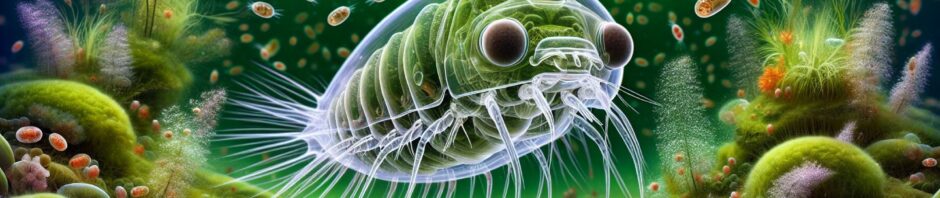
Among the myriad of organisms that play critical roles in the health and function of aquatic ecosystems, Daphnia, a member of the group Cladocera, have drawn considerable attention from scientists and environmentalists alike. Commonly known as water fleas, these small, seemingly inconsequential creatures are, in fact, powerhouses when it comes to their ecological importance, serving vital roles from filter feeding to biomonitoring.
Understanding Daphnia: An Overview
Daphnia are small, often transparent, freshwater crustaceans that belong to the broader category of aquatic invertebrates. They are considered planktonic organisms, which means they mostly drift through water columns and are not strong swimmers against currents. Despite their minute size, typically less than 5 millimeters, Daphnia play an outsized role in aquatic environments, particularly in relation to the food web dynamics and trophic levels they influence.
Taxonomy and Morphology
Daphnia belong to the order Cladocera and are characterized by their unique body structure, which sports a carapace—a kind of shell that encloses most of their body. This protective shield contributes to their common name as it causes them to appear as fleas hopping through the water when viewed under magnification.
Life Cycle and Reproductive Strategies
An intriguing fact about Daphnia is their dual reproductive strategy encompassing both parthenogenesis (asexual reproduction) and sexual reproduction. Most of the year, females reproduce asexually, producing clones that rapidly increase the population size. This mode of reproduction allows for exponential growth when environmental conditions are favorable.
However, when conditions deteriorate or seasons change, Daphnia switch to sexual reproduction, producing ephippia—resilient resting eggs that can withstand harsh conditions. These eggs are able to lie dormant during unfavorable periods, such as winter or drought, and hatch into a new population when the environment becomes hospitable again.
Daphnia’s Ecological Significance
The significance of Daphnia within freshwater ecosystems cannot be overstated. They serve multiple roles, from filter feeders that clear water from algal blooms to prey items that support a myriad of larger species.
Role as Filter Feeders
Daphnia are exceptional filter feeders, consuming small particles suspended in the water, including bacteria, detritus, and primarily, algae. Their feeding activities can significantly control algal populations, thereby maintaining water clarity and quality. This is a crucial service in preventing eutrophication, a process where water bodies become nutrient-rich, leading to excessive plant growth and oxygen depletion.
Biomonitoring and Water Quality Indicators
Due to their sensitive responses to environmental changes, Daphnia are often used as biological indicators to assess water quality and the presence of chemical pollutants. Daphnia’s health, population dynamics, and behavior can reflect the levels of toxicity in an aquatic environment, making them essential in ecotoxicology studies and environmental assessment.
Predators and Prey Relations
Daphnia are a fundamental food source for many aquatic species, including fish and insect larvae. Their population’s size and reproductive rate make them a reliable and crucial link within the food web. Predator-prey interactions with Daphnia can also provide valuable insight into the stability and health of freshwater ecosystems.
Influence on Nutrient Cycling
By feeding on algae and other microorganisms, Daphnia are instrumental in nutrient cycling within aquatic ecosystems. They help in the recycling of nitrogen and phosphorus, which are critical for the growth of aquatic plants and maintain the balance of these elements in water bodies, mitigating the risk of algal blooms and the consequent effects of eutrophication.
Daphnia as a Research Organism
Scientific interest in Daphnia extends beyond their role in the natural environment. Their relatively rapid life cycle, ease of cultivation, and the fact that they respond quickly to environmental changes make them ideal subjects for a variety of scientific studies.
Toxicity Testing
Daphnia are commonly employed in laboratory toxicity testing to evaluate the effects of chemical substances in the water, including pesticides, industrial chemicals, and pharmaceuticals. Standardized tests involving Daphnia can determine lethal concentrations of pollutants and help in regulating emissions and waste disposal practices.
Ecotoxicology and Environmental Assessment
Research in ecotoxicology often centers around the impact of pollutants on Daphnia, as their health can broadly reflect the conditions of their habitats. The ability to observe changes in the Daphnia population, from growth to reproductive success, makes them a practical tool for environmental assessment and monitoring.
Understanding Evolutionary Adaptations
Daphnia have been observed to show rapid evolutionary adaptations to changing environments. Studying these adaptations can provide insights into how populations respond to challenges such as shifts in predator abundance, temperature variations, and the introduction of new pollutants into aquatic systems.
Challenges Faced by Daphnia Populations
While Daphnia are adaptable, they face a myriad of challenges brought on by human activities. Factors such as climate change, habitat destruction, the introduction of non-native species, and the increasingly pervasive presence of various pollutants threaten Daphnia populations and the important ecological services they provide. Reduced populations can result in disruptions of aquatic food webs, decreased water quality, and loss of biodiversity.
The Effects of Changing Temperatures
Temperature fluctuations, particularly the rising temperatures associated with climate change, can have detrimental effects on Daphnia populations. These creatures are sensitive to temperature, which influences their metabolic rates, life cycles, and overall survivability.
Impact of Chemical Pollutants
Chemical pollutants from agricultural runoff, industrial waste, and other sources can have deleterious effects on Daphnia populations. Such pollutants can not only cause immediate mortality but also sublethal effects affecting reproduction, behavior, and predator-prey interactions.
Conclusion
The small but mighty Daphnia are far more than just water-dwelling invertebrates; they are essential components of the freshwater ecosystems in which they live. As natural filtration systems, indicators of environmental health, and key players in food web interactions, their ecological importance is immense. With the growing awareness of their role, researchers and environmentalists are keen to protect Daphnia and their habitats, ensuring that these aquatic ecosystems remain healthy and functional for generations to come.
Sources
- Ebert, D. (2005). Ecology, Epidemiology, and Evolution of Parasitism in Daphnia. Bethesda (MD): National Center for Biotechnology Information (US). Available from: https://www.ncbi.nlm.nih.gov/books/NBK2042/
- DeMott, W. R. (1989). The Role of Taste in Food Selection by Freshwater Zooplankton. Oecologia, 79(2), 334–340. https://doi.org/10.1007/BF00384331
- Lampert, W. (2011). Daphnia: Model Herbivore, Predator, and Prey. Polar Biology, 34(2), 171–183. https://doi.org/10.1007/s00300-010-0880-1
*Note: Since the user requested content in Markdown format, external links were not made clickable in keeping with basic Markdown syntax which does not recognize HTML