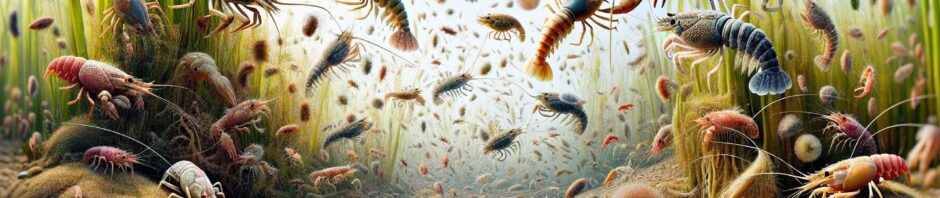
With over 10,000 species, freshwater crustaceans take diverse forms and sizes. From tiny Daphnia invisible to the naked eye, to bigger counterparts like crayfish, these aquatic invertebrates offer an intriguing ecosystem in their own right. Today we’ll explore some of these fascinating creatures and the roles they play in the ecosystem.
What are Freshwater Crustaceans?
They are aquatic animals that have exoskeletons, two pairs of tentacles, and body sections usually divided into the head, thorax, and abdomen. Most are free-living whereas some are parasites. They range from tiny Daphnia of a mere few millimeters when fully grown to the Tasmanian giant crayfish reaching up to 80 cm.
Notable Freshwater Crustaceans
-
Daphnia: Often referred to as “water fleas” due to their rapid jerky swimming pattern. They serve as an important food source for fish and other aquatic organisms. Their populations exhibit interesting dynamics such as cyclic parthenogenesis.
-
Freshwater Shrimp: Comes in many varieties, sizes, and colors. Apart from being part of an aquarium, they control the populations of other organisms.
-
Crayfish: Also called crawfish or crawdads, they are akin to small lobsters and are found all over the world except Africa.
The Role of Freshwater Crustaceans in Ecosystem
Freshwater crustaceans are part of the lower and middle trophic levels in the aquatic food web. They are powerful agents in recycling nutrients and controlling algae populations. As filter feeders, they play a significant role in improving water clarity as they consume phytoplankton and help control algal blooms.
Their behavior and population dynamics are also intensely researched and used for biomonitoring to study ecotoxicology and offer insights into water quality. Such assessments involve toxicity testing where crustaceans like Daphnia are exposed to different levels of pollutants, and their behavior and survival rates are monitored to indicate the water quality or the presence of harmful elements.
Threats to Freshwater Crustaceans
Freshwater crustaceans face several threats which include habitat loss, water pollution, invasive species, and climate change.
-
Habitat loss: Many bodies of freshwater are threatened by human activities like dam construction and drainage for agriculture.
-
Water pollution: An increase in chemical pollutants, from agricultural runoff, industrial waste, and plastics, disturb the water ecosystem and directly affect the survival of crustaceans.
-
Invasive species: They pose significant threats by outcompeting native species for food and habitat.
-
Climate change: Changes in water temperature and dissolved oxygen levels induced by climate change affect the survival and distribution of freshwater crustaceans.
Protecting Freshwater Crustaceans
Several steps can help protect freshwater habitats and the creatures that dwell in them. Habitat conservation is vital – this includes considering the ecological impact before constructing dams or modifying watercourses. Eliminating or reducing pollutants from entering water bodies and strict regulation of invasive species introduction can immensely save these habitats.
The field of conservation genomics is also providing promising methods to track populations, understand genetic diversity, and guide conservation decisions.
“Many species of freshwater crustaceans are highly adapted to their specific habitats and may not be able to survive if those habitats are destroyed,” echoes Andrew Turner from the Freshwater Biological Association [^1^].
In conclusion, freshwater crustaceans act as integral players in the aquatic ecosystems. Next time when you marvel at a serene lake or bubbling brook, remember there is an entire bustling world beneath the surface.
[^1^]: Conserving Freshwater Biodiversity, Freshwater Biological Association
[^2^]: Freshwater Invertebrates, Nature Education Knowledge
[^3^]: The hidden biodiversity in our homes: Invertebrates in domestic freshwaters, British Wildlife
[^4^]: How Freshwater Creatures Could Help Us Save the Planet, National Geographic
[^5^]: Current threats to freshwater fauna, Springer Link