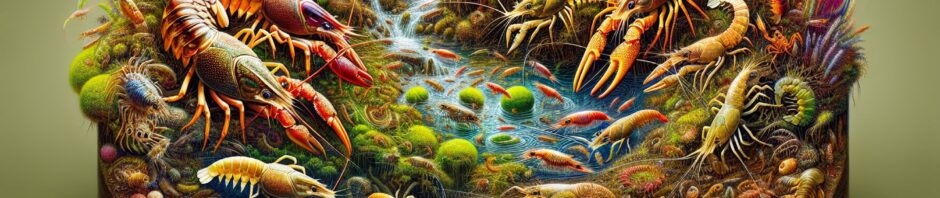
When we think about aquatic life, our mind probably wanders to stunning coral reefs, dolphins, and sharks. But there is a group of organisms that thrives in almost every freshwater body worldwide: Freshwater crustaceans. These critters may not be as glamorous as their marine counterparts, but their role and importance in maintaining the balance of aquatic ecosystems is irreplaceable. So, let’s dive in and unravel the fascinating realm of freshwater crustaceans.
A Spectacular Variety
Freshwater crustaceans are a diverse group, numbering over 10,000 species including crabs, lobsters, crayfish, shrimp, krill and, one of the most interesting of all, the water flea or daphnia[^1^]. Each species is uniquely adapted to different ecological niches and environments, reflecting the variety of life on our planet.
The Ecosystem’s Little Helpers
Many of these species play crucial roles in aquatic ecosystems. For instance, crayfish not only consume plant material, providing a control for excessive aquatic vegetation, but they also aerate soil and enhance its fertility by their burrowing activities[^2^]. The humble water flea plays an even more fascinating role. As filter feeders, they help to clean the aquatic environment by consuming microorganisms and algae, thus maintaining the water’s clarity and quality[^3^].
An Indicator of Water Quality
Interestingly, freshwater crustaceans can also act as useful indicators of environmental health. A sudden variation in their population often indicates a change in water quality, including the introduction of pollutants. In fact, certain species are used routinely in toxicity testing for water quality assessments[^4^].
Threats and Challenges
Unfortunately, freshwater crustaceans face numerous threats, primarily from human activities. Pollution from industrial effluents and agricultural runoff significantly alters the water chemistry, making it difficult for sensitive species to survive. Similarly, climate change and its associated extremes of rainfall and temperature also pose significant challenges.
Moreover, the introduction of non-native species into freshwater ecosystems often leads to intense competition for resources, with devastating effects on native crustacean populations[^5^].
Our Role in Their Survival
The need for conserving these tiny custodians of our water bodies cannot be overstated. As citizens, we can contribute to their survival by minimizing pollution and supporting responsible agriculture practices. Additionally, protecting and restoring natural habitats like forests that help filter water before it enters our rivers and lakes is critical. Engaging in citizen science programs that help track the health of local water bodies can also immensely aid in conservation efforts.
In Conclusion
So, the next time you gaze into a stream or a pond, remember there’s a bustling community of tiny freshwater crustaceans working tirelessly to keep the waters clean and the ecosystem functioning. The beautiful balance of nature is indeed in the details!
Keep exploring the wonderful world of nature, and until next time, stay curious!
And remember, every single action – no matter how small – can make a difference to the health of our planet.
[^1^]: Williams, W.D. (1998). Global diversity in freshwater and estuarine crustaceans. In: Fitter, R., & Rafaelli, D. (Eds.), Ecological Diversity in Theory and Practice. Island Press.
[^2^]: Usio, N., & Townsend, C. (2004). Roles of crayfish: consequences of predation and bioturbation for stream invertebrates. Ecology, 85(3), 807-822.
[^3^]: Lampert, W. (2006). Daphnia: model herbivore, predator and prey. Polish Journal of Ecology,54(4), 607-620.
[^4^]: De Cooman, Winsome, Bossuyt, Bart Traas, Theo, Janssen, Colin (2001). Ecotoxicological risk assessment using the water flea Daphnia. Laboratory Animals, 2(35), 265–274.
[^5^]: Ricciardi, A., & Rasmussen, J. B. (1999). Extinction rates of North American freshwater fauna. Conservation Biology, 13(5), 1220-1222.