Hello fellow Aquatic aficionados!
During our underwater explorations, it’s not unusual to be mesmerized by the vibrant swathes of dazzling corals, shoals of colorful fish, or the majestic dance of the elusive octopus. However, what often escapes our notice are the silent workhorses of the aquatic world, the unsung heroes that keep the machineries of the aquatic ecosystems running super smooth. They might not be as flashy or easily noticeable, but their ecological significance is nothing short of immense. Yes, we’re talking about our tiny friends – Zooplankton!
Zooplankton might not get the spotlight as often as other larger life forms, but they play a pivotal role across a range of ecological domains. This is exactly what we’re going to ponder on today. So, put on your academic snorkels because we are about to deep-dive into the fascinating world of Zooplankton!
What are Zooplankton?
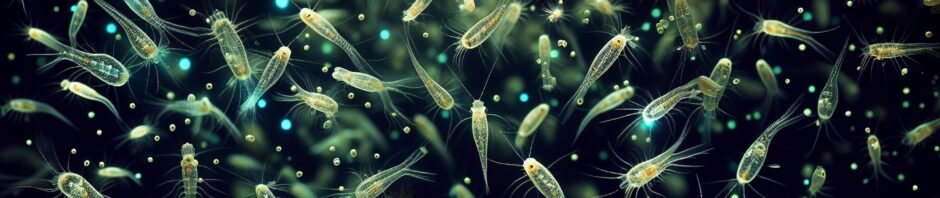
To set the stage, let’s clarify what we mean by Zooplankton. From the Greek for “animal drifters,” Zooplankton consists of myriads of tiny aquatic organisms that inhabit the world’s sea, lake, river, and pond waters. They include several species of tiny animals such as small crustaceans like copepods, rotifers, and water fleas, juvenile stages of larger animals like fish and jellyfish, and single-celled protozoa among others [1].
The Central Role of Zooplankton in the Aquatic Food Web
In the grand scheme of the aquatic ecosystem, Zooplankton are stationed just above Phytoplankton (tiny plant-like organisms) on the food web, and they primarily feed on them. Owing to this, Zooplankton play a cardinal role of converting the Sun’s energy, which the Phytoplankton photosynthesized, into a form that can be accessed and utilized by numerous other creatures on the trophic levels above. Without them, the energy flow through the food web would cease, leading to havoc in the ecosystem [2].
Zooplankton as Indicators of Water Quality and Climate Change
What’s incredible is Zooplankton’s role doesn’t just stop at energy flow regulation. They are also invaluable in bio-monitoring studies where they serve as water quality indicators. By analyzing the type and number of specific Zooplankton species in a water body, scientists can assess its overall health and even identify the presence of certain pollutants. Additionally, shifts in Zooplankton communities are often the first sign of climate change impacts on aquatic ecosystems, enabling mitigation measures to be implemented in time [3].
Zooplankton’s Remarkable Life Cycle and Reproduction
Dwelling on Zooplankton’s lifestyle, they exhibit a fascinating array of reproductive strategies to cope up with their challenging environment. The most common form is parthenogenesis, where females produce viable offspring without fertilization. However, most species can also reproduce sexually which often occurs in harsh conditions to ensure genetic diversity for survival.
Beyond reproduction, Zooplankton exhibit brilliant evolutionary adaptations that provide them the upper hand in negotiating their fluid world. Obesity, for instance, reduces their sinking rates in water, while the development of spines and spikes provide protection from predators.
Conclusion: Zooplankton – The Invisible Giants of The Aquatic World
Overall, the role Zooplankton play in the maintenance and functioning of aquatic ecosystems qualifies them as “invisible giants” of the underwater world. They are the necessary cogs without which the aquatic machinery won’t function. However, their significantly large biomass and ubiquity make them vulnerable to threats like climate change and pollution. As we continue our journey of exploration and understanding of the aquatic world, for these invaluable life forms, let us aim for both marveling at their resilience and a commitment to their protection. In the end, the health of Zooplankton is the health of our waters!
Sources: