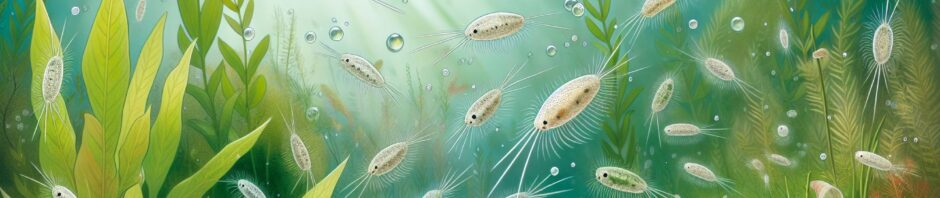
Water is the lifeblood of our planet – an essential resource that supports a vast diversity of life. Within every drop of freshwater, there is a thriving community of organisms that play critical roles in maintaining the health and stability of aquatic ecosystems. Among these organisms, Daphnia, often referred to as water fleas, are of particular scientific interest due to their sensitivity to environmental changes and their pivotal position in freshwater food webs.
Introduction to Daphnia
Daphnia are small planktonic crustaceans belonging to the order Cladocera. They are commonly found in a variety of freshwater environments, including ponds, lakes, and streams. Daphnia are characterized by their transparent exoskeleton and the ability to reproduce both sexually and asexually through a process known as parthenogenesis. These fascinating creatures are more than mere inhabitants of water bodies; they are vital players in ecological research and environmental management.
The Life Cycle of Daphnia
Daphnia’s life cycle is complex and adaptive, allowing them to rapidly respond to changing environmental conditions. During favorable conditions, Daphnia reproduce through parthenogenesis, where females produce clones of themselves without the need for fertilization. This leads to explosive population growth. When environmental stressors such as food scarcity, overcrowding, or changes in water quality occur, Daphnia switch to sexual reproduction, producing resting eggs known as ephippia. These ephippia can withstand harsh conditions and hatch when the environment becomes favorable again.
Population Dynamics and Trophic Levels
Daphnia play a crucial role at several trophic levels in the food web. As filter feeders, they consume algae and bacteria, effectively regulating algal blooms and nutrient cycling. This can have a direct impact on the clarity and overall health of freshwater systems. Moreover, they serve as a food source for a variety of fish and other predators. Hence, the population dynamics of Daphnia can significantly influence higher trophic levels and the overall stability of ecosystems.
Daphnia as Bioindicators and Water Quality Indicators
Due to their rapid reproductive rate and sensitivity to changes in water quality, Daphnia are widely used as bioindicators in environmental assessment and toxicity testing. Changes in their behavior, reproduction, and survival rates can indicate the presence of chemical pollutants, such as pesticides, heavy metals, and other hazardous substances. Biomonitoring with Daphnia is a cost-effective and reliable method for assessing the impact of pollutants on aquatic ecosystems.
The Role in Aquatic Ecosystems
In aquatic ecosystems, Daphnia play a pivotal role in the transfer of energy from primary producers to higher trophic levels. By grazing on phytoplankton, they help control algal populations and contribute to nutrient cycling. Furthermore, their presence can enhance water clarity by reducing the amount of suspended particles through their filtration activities.
The Impact of Environmental Factors
Temperature Effects
Temperature plays a significant role in the life processes of Daphnia. Warmer waters can accelerate their metabolism, resulting in faster growth rates and earlier maturity. However, extreme temperatures, whether too hot or too cold, can lead to physiological stress and even mortality.
Eutrophication and Algal Blooms
Eutrophication, the enrichment of an ecosystem with nutrients, can lead to excessive growth of algae. This can cause problems such as hypoxia (low dissolved oxygen) due to the decomposition of algal biomass. Daphnia can mitigate these effects by feeding on the excess algae, although if algal blooms are severe, they can deplete the Daphnia population and destabilize the ecosystem.
Chemical Pollutants
Daphnia are vulnerable to a range of chemical pollutants, including pesticides, industrial chemicals, and pharmaceuticals. Their response to these pollutants is often used for ecotoxicological studies. Such research enables scientists to understand the sublethal and lethal concentrations of various compounds and their potential impact on the environment.
The Importance of Daphnia in Research and Environmental Protection
Ecotoxicology, the study of the effects of toxic chemicals on biological organisms and ecosystems, heavily relies on Daphnia as a model organism. The European Chemicals Agency’s REACH program, which stands for Registration, Evaluation, Authorisation, and Restriction of Chemicals, outlines guidelines for using Daphnia in standard toxicity tests, highlighting their significance in regulatory contexts.
Behavioral Responses and Evolutionary Adaptations
Daphnia exhibit various behavioral responses to evade predators, such as vertical migration and shifts in their swimming patterns. Researchers study these adaptive behaviors to understand how evolutionary pressures shape the survival strategies of aquatic invertebrates.
Contributions to Scientific Discovery
Research on Daphnia has provided insights into fundamental biological processes such as aging, the effects of stressors on development, and population genetics. Their high rate of reproduction and short lifespan make them ideal subjects for studying evolutionary adaptations and long-term environmental changes.
Conclusion
Daphnia are much more than mere dots swimming in our freshwater resources; they are sentinels that guard the health of aquatic ecosystems and indicators that help us assess our environmental practices. Their unique biological characteristics and intrinsic role in aquatic ecosystems make them a focus of ongoing research with far-reaching implications for ecology, environmental policy, and public health.
Understanding and protecting these tiny titans is crucial for maintaining the equilibrium of our planet’s delicate freshwater habitats. By supporting research on Daphnia and other freshwater organisms, we can develop better strategies for preserving water quality and the countless species that depend on clean and stable aquatic environments.
Sources
- Lampert, W. (2011). Daphnia: development of a model organism in ecology and evolution. Excellence in Ecology, 21. International Ecology Institute.
- Dodson, S. I., and Frey, D. G. (1991). Cladocera and Other Branchiopoda. In Ecology and Classification of North American Freshwater Invertebrates. Academic Press.
- European Chemicals Agency. (2008). Guidance on information requirements and chemical safety assessment. Chapter R.7B: Endpoint specific guidance. Helsinki, Finland.
By studying these environmental champions, we can learn to make informed decisions that ultimately benefit both our ecosystems and ourselves, emphasizing the deep connection we share with even the smallest inhabitants of our planet.