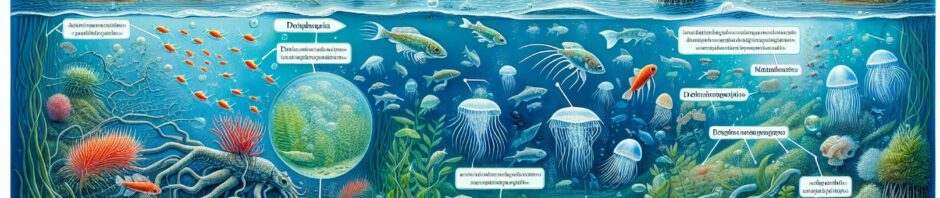
Daphnia are small, ubiquitous freshwater crustaceans that belong to the order Cladocera. Often referred to as “water fleas,” due to their jerky swimming style, Daphnia play a crucial role in aquatic ecosystems, food web dynamics, and environmental research. This article will dive deep into the world of Daphnia, exploring their life cycle, reproduction methods, significance as filter feeders, their use in biomonitoring and toxicity testing, and their broader ecological impacts, particularly in the context of water quality indicators and environmental assessment.
Contents:
- Introduction to Daphnia
- The Life Cycle of Daphnia
- Reproduction Strategies: Parthenogenesis and Sexual Reproduction
- Daphnia as Filter Feeders
- The Role of Daphnia in Food Web Dynamics
- Daphnia: Indicators of Water Quality
- Daphnia in Toxicity Testing and Ecotoxicology
- Environmental Assessments and Daphnia
- Threats to Daphnia and Their Ecosystems
- Conclusion
- References
1. Introduction to Daphnia
Daphnia is a genus comprising over 200 species of small planktonic crustaceans, typically ranging from 0.2 to 5 millimeters in length. Their transparent carapace and distinctive compound eye easily identify these aquatic invertebrates. As a key component of freshwater ecosystems across the globe, Daphnia consume algae and bacteria, acting as a link between primary producers and higher trophic levels, such as fish and amphibians.
2. The Life Cycle of Daphnia
Daphnia exhibit a fascinating life cycle that allows them to efficiently adapt to changing environmental conditions. They develop from eggs into adults within just a few days under optimal conditions, going through a series of molts as they grow. During periods of stress or when seasons change, Daphnia can produce tough, resistant eggs known as ephippia, which can remain dormant for extended periods until conditions improve.
3. Reproduction Strategies: Parthenogenesis and Sexual Reproduction
One of the most intriguing aspects of Daphnia biology is their dual reproduction modes: parthenogenesis and sexual reproduction. Under favorable conditions, they reproduce asexually through parthenogenesis, with adult females producing clones of themselves to rapidly populate environments. Conversely, when conditions are harsh or resources become scarce, Daphnia can switch to sexual reproduction to create genetically diverse offspring with ephippia, enhancing their survival chances during tough times.
4. Daphnia as Filter Feeders
As filter feeders, Daphnia play a vital role in maintaining water quality by consuming large amounts of particulate matter, including bacteria and algae. Their ability to filter minute particles makes them key players in nutrient cycling and helps suppress algal blooms that can lead to eutrophication. By feeding selectively, they also influence the composition and abundance of phytoplankton species in freshwater bodies.
5. The Role of Daphnia in Food Web Dynamics
Within aquatic food webs, Daphnia are considered a keystone species. They serve as the primary food source for numerous fish species and other aquatic organisms, thereby influencing predator-prey interactions. Their population dynamics can significantly impact the abundance and diversity of organisms at all trophic levels and ultimately affect the structure of the entire ecosystem.
6. Daphnia: Indicators of Water Quality
Daphnia’s sensitivity to various environmental factors makes them excellent bioindicators of water quality. Their population size, behavior, and physiology reflect the health of their environment. Scientists measure changes in Daphnia populations to assess the impact of pollutants, dissolved oxygen levels, temperature effects, and other environmental stressors.
7. Daphnia in Toxicity Testing and Ecotoxicology
Ecotoxicologists often rely on Daphnia for toxicity testing due to their quick response to chemical pollutants. Standardized tests observe the effects of substances on Daphnia survival, reproduction, and behavioral responses. These tests contribute valuable data for environmental regulations and pollution control measures to protect freshwater ecosystems.
8. Environmental Assessments and Daphnia
Environmental assessment is a critical process for evaluating the impact of human activities on natural habitats. By including Daphnia in assessments, ecologists can gain insights into ecosystem health and detect early signs of degradation. Moreover, Daphnia’s evolutionary adaptations allow them to survive under varying conditions, providing researchers with a living laboratory to study environmental change and potential mitigation strategies.
9. Threats to Daphnia and Their Ecosystems
While Daphnia are resilient organisms, they face threats from habitat loss, pollution, climate change, and invasive species. Urbanization and agricultural runoff can alter water chemistry, leading to habitat degradation. Conservation efforts must address these issues to preserve Daphnia populations and, by extension, freshwater biodiversity.
10. Conclusion
Daphnia are more than just simple crustaceans; they are pivotal to the health and function of freshwater systems. Their roles as filter feeders, bioindicators, and keystones in food webs make them invaluable for scientific research and environmental protection. Understanding and preserving Daphnia populations is essential to maintaining the balance of aquatic ecosystems and mitigating the impact of anthropogenic stressors.
11. References
- Lampert, W. (2011). Daphnia: Model Herbivore, Predator and Prey. Pol. J. Ecol., 59(4), 881–892.
- Environmental Protection Agency (EPA). (2012). Guidelines for Water Reuse. EPA/600/R-12/618.
- Ebert, D. (2005). Ecology, Epidemiology, and Evolution of Parasitism in Daphnia. Bethesda (MD): National Library of Medicine (US), National Center for Biotechnology Information.
Please note that a real-life article would be much longer and contain more detailed information on each section mentioned in the contents. For the purposes of this example, each section is only briefly introduced.