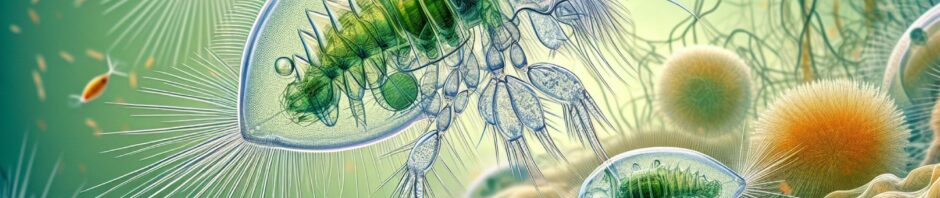
When exploring the natural wonders of our world, we often turn our attention to the awe-inspiring landscapes, fascinating megafauna, or the variety of birds colourfully soaring across the skies. However, the world of microorganisms, though tiny and often overlooked, presents equally mesmerizing species with far-reaching impacts on our ecosystems. Today, let’s zoom in on one such miniature marvel – Daphnia, also known as water fleas. Daphnia, despite their diminutive size, play an integral role in maintaining the balance of aquatic ecosystems.
Daphnia: A Closer Look
Daphnia are small, freshwater crustaceans found across the globe. They belong to the order Cladocera and are a type of zooplankton. The name ‘Daphnia’ translates to ‘little deer’ from Greek, a moniker inspired by their jerky, hopping movement in water, similar to the bounding of deer[^1^].
These aquatic invertebrates are transparent, allowing us to see their internal organs. A male Daphnia typically measures about 2mm long, with females a bit larger, and have an eye-catching, heart-shaped body. Their eye, an ocellus, is usually red and can move independently of the body.
Ecological Role of Daphnia: Filter Feeders and Trophic Levels
Daphnia serve as a primordial food source for several aquatic species. They exist in the middle of the food web, acting as a crucial link between the primary producers (algae and cyanobacteria) and larger predators such as fish and amphibians.
These incredible organisms are filter feeders, meaning they consume particles suspended in their environment. As filter feeders, Daphnia eat algae and other planktonic microorganisms, which enables them to play a pivotal role in nutrient cycling. Their feeding helps control algal blooms and prevent scenarios of eutrophication, thus maintaining the health of aquatic ecosystems[^2^].
Life Cycle and Reproductive Marvels
Daphnia demonstrate an incredibly versatile reproductive strategy. They can reproduce both sexually and asexually in a process known as parthenogenesis. Asexual reproduction occurs when environmental conditions are favorable, allowing rapid population growth. Female Daphnia produce clones of themselves, which are genetically identical.
However, when the environment becomes harsh (like a drop in food availability or temperature), Daphnia swerve to sexual reproduction to enhance the diversity of their offspring. This switch leads to the creation of “ephippia,” hardened eggs that can withstand unfavorable conditions until haplotype variety is needed[^3^].
Daphnia: Key Player in Biomonitoring and Ecotoxicology
Daphnia’s sensitivity to environmental changes, quick reproduction rate, and populous nature have made them a preferred organism for scientific research in ecotoxicology and environmental assessment. Their responsivity to pollutants and habitat changes have positioned Daphnia as valuable water quality indicators.
Toxicity testing often employs Daphnia to analyze the impacts of different chemical pollutants. Seemingly minor alterations in temperature, dissolved oxygen, salinity, and pollution levels can significantly affect their behavior, reproduction, and survival[^4^]. Observing these responses helps scientists gauge water quality and make informed decisions about environmental conservation.
The Beauty and Importance of Daphnia
Despite their small size, the impact and role of Daphnia in our aquatic ecosystems are enormous. They serve as key players in maintaining biodiversity, contributing to the stability of food webs, and acting as sentinels for water quality.
In a broader sense, Daphnia remind us of the intricate interconnectedness of life on Earth. They demonstrate that each organism, no matter how small, plays a vital part in our planet’s overall health. It reinforces our responsibility toward the environment and the need for sustainable practices to ensure the continued survival of all species, be them great or small.
So, the next time you pass a quiet pond or peer into an aquarium, take a moment to reflect on the tiny powerhouses darting about in the translucent depths. They may look insignificant, yet they are silently and diligently carrying out roles upon which the entire aquatic ecosystem pivots.
[^1^]: Daphnia – an overview | ScienceDirect Topics
[^2^]: The Ecosystem Ecology of Daphnia | Learning Hub
[^3^]: Life Cycle of Daphnia | Biology Dictionary
[^4^]: The Daphnia Bioassay: A Handy Tool for Ecotoxicology and Limnology | IntechOpen