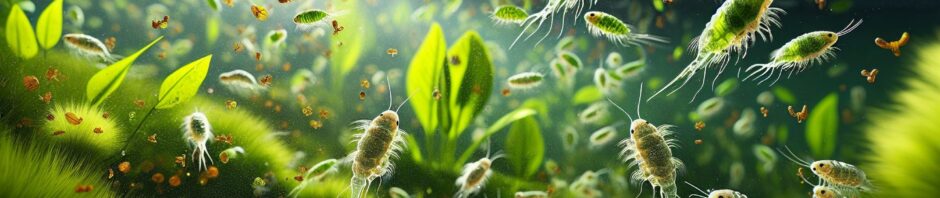
Freshwater ecosystems are the lifeblood of our planet, nurturing an enormous variety of plants and animals while providing essential services to human populations. At the heart of these aquatic ecosystems lies a group of tiny but mighty organisms known as Daphnia. Often referred to as water fleas due to their jerky swimming movements, Daphnia are minuscule planktonic crustaceans that play a pivotal role in the health and stability of freshwaters around the world.
Understanding Daphnia: A Microscopic Glimpse
Despite their small size – typically between 0.2 and 5 millimeters in length – Daphnia pack a big punch when it comes to their ecological importance. They belong to the group known as Cladocera, a subset of the broad category of aquatic invertebrates that are crucial for the well-being of our freshwater ecosystems. As filter feeders, Daphnia consume algae, bacteria, and other microorganisms, making them an integral part of nutrient cycling and the aquatic food web.
The Role in Aquatic Ecosystems: A Trophic Balancing Act
Daphnia serve as a critical food source for a variety of fish and insect larvae, positioning them as a vital component in the food web dynamics of aquatic ecosystems. The health and population dynamics of Daphnia can dramatically affect the entire food web, influencing the trophic levels above and below them. Their reproductive strategy, which includes both asexual reproduction known as parthenogenesis and sexual reproduction, allows for rapid population growth and adaptability to changing environmental conditions.
Water Quality Indicators and Biomonitoring
One reason why so much scientific attention is paid to these freshwater crustaceans is their sensitivity to changes in water quality. They are excellent water quality indicators, whose presence and health can provide early warning signs of environmental stress or pollution. Daphnia’s reactions to environmental changes, such as alterations in dissolved oxygen levels, temperature variations, and the presence of chemical pollutants, make them ideal subjects for biomonitoring. Researchers employ Daphnia in toxicity testing and ecotoxicology to assess the impact of various substances and to inform environmental assessment practices.
Daphnia and Human Impact: An Inseparable Relationship
Human activities have a profound impact on Daphnia populations and their ecosystems. Urban runoff, agricultural practices, and industrial discharges can result in algal blooms, eutrophication, and the introduction of noxious chemicals into freshwater habitats. These changes can alter Daphnia’s life cycle, reproductive success, and their interactions with predators and prey, potentially leading to profound effects on the aquatic ecosystems they inhabit.
Algal Blooms and Eutrophication
When excess nutrients from fertilizers and other sources wash into water bodies, they can give rise to algal blooms. While Daphnia can initially benefit from an increase in their food source, the subsequent die-off of algae can sap the water of dissolved oxygen and create dead zones inhospitable to most aquatic life, including Daphnia. The disappearance of these filter feeders then exacerbates the problem by reducing the ability of the ecosystem to naturally control algal populations.
Temperature and Oxygen: The Invisible Drivers of Daphnia’s Well-being
Temperature and dissolved oxygen levels are significant factors affecting the survival and distribution of Daphnia. Higher temperatures, often resulting from climate change or thermal pollution, can stress these organisms and even lead to large-scale die-offs. Oxygen availability is also crucial for Daphnia. Oxygen requirements change throughout their life cycles, and low dissolved oxygen conditions, often a result of organic pollution, can severely impact their populations.
The Response to Environmental Challenges: Behavioral and Evolutionary Adaptations
Daphnia exhibit a variety of behavioral responses and evolutionary adaptations that enable them to survive in their often-changing environment. Their diurnal vertical migration, moving up and down in the water column to avoid predators, and their ability to produce resting eggs (ephippia) that can withstand adverse conditions, are just a couple examples of their resilience and adaptability.
Predator-Prey Interactions and Population Dynamics
Daphnia are not just passive victims of their circumstances; their populations can also influence the predators that rely on them for sustenance. Their lucid and rapid swimming behaviors are both a means to efficiently filter-feed and evade predation. The interplay between Daphnia and their predators is a constant dance of adaptation – a microcosm of evolutionary forces and natural selection.
Toxicity Testing and the Future of Ecotoxicology
As models in toxicity testing, Daphnia provide valuable insights into the effects of environmental pollutants on biodiversity and ecosystem health. Their short life cycle and the feasibility of observing their physiological and reproductive responses make them prime candidates for laboratory research, contributing to the broader field of ecotoxicology.
In the field of environmental assessment, the patterns and findings derived from studying Daphnia are used to design and enforce regulations aimed at protecting our freshwater resources. Through careful monitoring and responsible stewardship, we can help ensure that Daphnia, and the larger ecosystems they represent, continue to thrive.
In Conclusion: The Centrality of the Microscopic
While they may often go unnoticed due to their diminutive stature, Daphnia are giants in the ecological narrative of freshwater habitats. They are the connectors in the web of aquatic life, influencing the dynamics of the environments they inhabit and reflecting the health of our precious water bodies. As sentinel species, Daphnia not only inform us about the state of our environment but also highlight the interconnectedness of all life. We have much to learn from these tiny organisms, and it is our responsibility to protect the waters they call home.
Sources
To delve deeper into the fascinating world of Daphnia and their role in our ecosystems, please consult the following resources:
- Ebert, D. (2005). “Ecology, Epidemiology, and Evolution of Parasitism in Daphnia”. National Center for Biotechnology Information, U.S. National Library of Medicine. [link]
- Lampert, W. (2011). “Daphnia: Model Herbivore, Predator and Prey”. Polskie Archiwum Hydrobiologii. [link]
- Sibly, R. M., et al. (Eds.). (2005). “Ecotoxicology: The Study of Pollutants in Ecosystems”. Academic Press. [link]
By understanding and protecting the delicate balances within our aquatic environments, we are not only safeguarding species like Daphnia but also preserving the integrity of our own future on this blue planet.