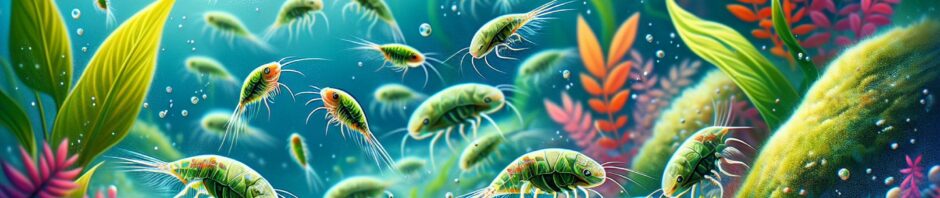
Daphnia, those tiny freshwater crustaceans often referred to as “water fleas,” are easily overlooked by many due to their minuscule size. Yet, these unassuming aquatic invertebrates play a monumental role in the environment, especially within their freshwater habitats. This article delves into the fascinating world of Daphnia, highlighting their life cycle, their critical position in food webs, and how they serve as bioindicators for environmental health.
Introduction to Daphnia
Daphnia belong to the class Cladocera and are a suborder of crustaceans found in a variety of freshwater environments, including ponds, lakes, and streams. They are a key component of the zooplankton community, drifting at the mercy of water currents, yet are also capable of making controlled movements through their habitat.
The Life Cycle of Daphnia
The life cycle of Daphnia is particularly intriguing due to their ability to reproduce both asexually through parthenogenesis and sexually. During favorable conditions, Daphnia populations can explode, with females reproducing asexually to rapidly produce genetically identical offspring. This allows for quick colonization and adaptation to stable environments.
However, as conditions deteriorate or seasonally change, Daphnia switch to sexual reproduction, producing a type of resting egg known as ephippia. These ephippia ensure survival through harsh conditions such as winter freezes or droughts and lead to a more genetically diverse population, which is beneficial for adapting to changing environments.
Daphnia in the Food Web: Trophic Levels and Food Web Dynamics
Daphnia are filter feeders, consuming microscopic particles in the water, particularly algae, bacteria, and other small organic matter. By doing so, they play a pivotal role in nutrient cycling and help to keep water bodies clean. They are also an important food source for larger organisms like fish and insects, thus occupying a vital position in aquatic food webs and influencing food web dynamics.
As primary consumers in the food web, Daphnia are involved in the transfer of energy from primary producers (algae and phytoplankton) to secondary consumers (small fish and juvenile stages of larger fish). They are key in maintaining the balance and structure of aquatic communities.
Biomonitoring: Daphnia as Water Quality Indicators
Perhaps one of Daphnia’s most valued roles is their use in biomonitoring—serving as indicators of water quality and environmental health. Due to their sensitivity to various pollutants, researchers and environmental agencies use Daphnia in toxicity testing and ecotoxicology studies to assess the impact of chemicals and other pollutants on aquatic ecosystems.
The behavioral responses and population dynamics of Daphnia can reveal a great deal about the health of their environment. Changes in reproductive rates, growth, mortality, and general activity can all signal that something is amiss in the ecosystem, indicating the presence of chemical pollutants, changes in dissolved oxygen levels, or temperature effects.
Daphnia and Environmental Assessment: The Effects of Eutrophication and Algal Blooms
One of the significant environmental challenges Daphnia help us understand is eutrophication, a process driven by excess nutrients (primarily nitrogen and phosphorus) entering water bodies. These nutrients can lead to algal blooms, which, when decomposed, deplete dissolved oxygen levels and can result in dead zones, areas where life is unsustainable.
In healthy ecosystems, Daphnia can help control algae populations through their feeding habits. However, during severe blooms, they may not be able to keep up due to reductions in water clarity or oxygen fluctuations. Monitoring Daphnia populations can provide early warnings about eutrophication and help to inform strategies for its management.
Climate Change and Daphnia: Adapting to a Changing World
Climate change is bringing alterations to aquatic ecosystems that affect Daphnia. Changes in temperature have direct and indirect effects on their survival, reproduction, and the timing of their life cycle events. Daphnia, like many planktonic organisms, display a range of behavioral responses and evolutionary adaptations to cope with these changes.
Conclusion: Why Daphnia Matter
From their role as prey in aquatic food chains to sentinel species signaling the health of their environment, Daphnia are invaluable in myriad ecological and research contexts. Their presence and wellbeing are central to the health and stability of aquatic ecosystems, making them a critical focus for conservation efforts and environmental assessments.
By understanding the unique characteristics and ecological importance of Daphnia, we can better appreciate these tiny organisms that exert an outsized influence on freshwater habitats. Through continued study and protection of Daphnia, we can strive to maintain the balance of our aquatic environments for the benefit of all species that depend on them.
Sources
- Lampert, W. (2011). Daphnia: Development of a Model Organism in Ecology and Evolution (Vol. 21). Oldendorf/Luhe, Germany: International Ecology Institute.
- USEPA. (2016). Aquatic Life Ambient Water Quality Criterion for Ammonia – Freshwater. Retrieved from https://www.epa.gov/sites/default/files/2015-08/documents/aquatic-life-ambient-water-quality-criterion-for-ammonia-freshwater-2013.pdf
- Ebert, D. (2005). Ecology, Epidemiology, and Evolution of Parasitism in Daphnia. Bethesda, MD: National Center for Biotechnology Information (US). Retrieved from https://www.ncbi.nlm.nih.gov/books/NBK2036/