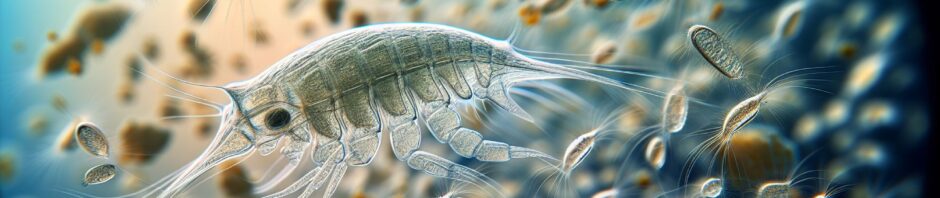
In the lush, aquatic world beneath the surface of lakes, ponds, and other freshwater bodies, a tiny organism is making big impacts on the health of the whole ecosystem. Meet Daphnia, a small crustacean also known as the water flea. This fascinating invertebrate is crucial to understanding our aquatic environments and maintaining water quality, despite its minuscule size.
The Anatomy of a Daphnia
Daphnia belong to the Cladocera order, a group of small, predominantly freshwater crustaceans often referred to as water fleas because of their quick, jerky manner of swimming^1^. Ranging from about 0.2 to 5 millimeters in length, Daphnia aren’t visible to the naked eye, but under a microscope, their transparent exoskeletons reveal an intricate internal structure.
An interesting feature of these little water fleas is their large, compound eye, responsive to changes in light intensity, which undulates rhythmically as their heart, located in the back of their head, beats at a fast pace. The rhythm not only fascinates the observers but acts as an excellent bio-indicator of water quality– more on that later.
The Life and Behaviour of Daphnia
Daphnia are filter feeders. Their large antennae generate currents that draw in detritus, bacteria, algae, and other microscopic food particles into their mouth, where it is enveloped into a food bolus and passed through their digestive system. This process not only nourishes Daphnia but also effectively cycles nutrients and controls algal populations in water bodies, preventing disruptive algal blooms[^2^].
The life cycle of Daphnia is shaped by a strategy known as cyclical parthenogenesis, meaning they can reproduce both sexually and asexually based on environmental conditions[^3^]. When resources are plentiful, females produce genetically identical daughters without the need for fertilization. It’s a way for the population to rapidly increase during favorable conditions. However, when conditions take a turn for the worse and resources become few and far between, females produce sons and special eggs that require fertilization. Once fertilized, these eggs are encased in a protective shell to form a resting egg, also known as an ephippium, which can withstand harsh conditions and remain dormant for years until conditions improve.
Daphnia as Bioindicators of Water Quality
Daphnia’s sensitivity to changes in water quality and their fundamental roles within aquatic ecosystems mean these tiny crustaceans are often used as bioindicators in ecotoxicology and biomonitoring[^3^]. By observing Daphnia’s heartbeat, reproduction, population dynamics, and overall health, scientists can indirectly measure the quality of the water and assess the presence of harmful contaminants. If the Daphnia show signs of stress or population decline, it’s often an alarm that the water quality has deteriorated.
The use of Daphnia for toxicity testing is another major aspect of environmental assessment. These creatures are used to test the effects of various chemical pollutants, not just on their own health but also how it can impact the balance of aquatic ecosystems at large. They efficiently process these chemicals, allowing scientists to monitor the effects of pollutants on their behavior and physiology, which can then be used to extrapolate potential effects on larger scales[^4^].
Daphnia offer a convenient and ecological way of monitoring water quality, providing valuable early warning signals of water contamination and contributing to our understanding of aquatic ecosystems.
Conclusion
The part played by Daphnia in food web dynamics, nutrient cycling, and their important status as a bioindicator makes them a vital organism in our freshwater habitats. Despite their micro size, they serve macro roles in maintaining the aquatic environment. They are integrally connected to the life cycles of many other aquatic species, and their unseen role is crucial to the environmental health of our planet. Their investigative use in ecotoxicology demonstrates the saying that small things count – and in the case of Daphnia, count enormously.
[^2^]: The role of Daphnia in aquatic food webs
[^3^]: Life-cycle switching in Daphnia
[^4^]: Aquatic toxicity testing using the cladoceran, Daphnia