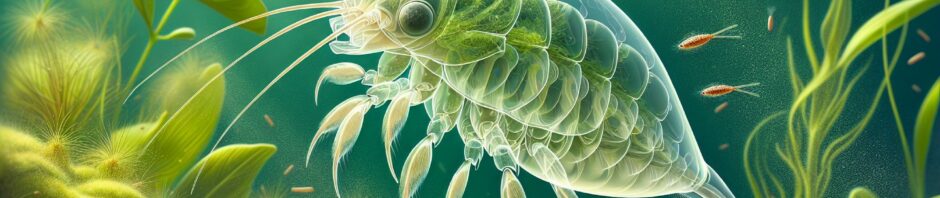
Daphnia or most popularly known as ‘water fleas’ are small crustaceans that belong to the parenthetic larvae order Cladocera [^1^]. Although they are minuscule, around 0.2-3 mm in size, don’t let their size put you off- they are power-packed creatures with remarkable abilities and features. It’s their world in ponds, lakes, and wetlands where they play essential roles in energy flow and nutrient cycling. Ready to dive into the fascinating world of Daphnia? Let’s go!
Life Cycle and Reproduction
The lifespan of Daphnia is relatively short, typically a few months, but it’s an exciting journey. A highly fascinating aspect of Daphnia is its reproduction strategy, which involves both asexual reproduction (parthenogenesis) and sexual reproduction, depending on environmental conditions [^2^].
During favourable conditions, females produce eggs via parthenogenesis. These eggs do not require fertilization and develop into genetically identical offspring, leading to rapid population growth. When the environment turns harsh, Daphnia employs sexual reproduction. Males appear, mate with females, and the resulting fertilized eggs are encapsulated within a protective cover, known as ‘ephippia’ [^3^].
Ecological Role
With a filter-feeding mode of nutrition, Daphnia grazes on bacteria, algae and other particles in the water column, converting these into edible material for larger animals [^4^]. Daphnia forms an integral part of many freshwater food webs, existing at the middle trophic levels and serving as a link between primary producers (like algae and plants) and higher trophic levels, including fish.
Consequently, fluctuations in Daphnia populations may significantly affect the dynamics of the entire food chain, by influencing prey availability for larger predators and controlling the population of phytoplankton through grazing.
Daphnia in Biomonitoring
One of the reasons scientists are so interested in Daphnia is their excellent biomonitoring potential. They are commonly used in ecotoxicology for assessing water quality and testing the toxicity of chemicals [^5^].
Why, you ask? Well, Daphnia are sensitive to changes in environmental and water conditions, like pollution or temperature changes, and they respond to these changes in a variety of ways, including developmental, behavioural, and reproductive modifications.
By observing these changes, scientists can gain useful insights about the quality of the water body and the presence of harmful pollutants. These remarkable creatures function as real-time, living indicators of aquatic health.
Predator-prey Interactions and Evolutionary Adaptations
There’s more! Daphnia‘s story takes an even more exciting twist when it comes to predator-prey interactions. When these small crustaceans sense chemical cues from predators, they react by producing offspring with protective traits, such as larger size or long spines, reducing predation risk [^6^].
This kind of rapid, responsive adaptability to environmental stressors is one of nature’s fascinating instances of evolutionary adaptations, highlighting the continuing evolution of life in action.
The Wonder of Daphnia
So, as you see, Daphnia may be tiny, but their impact on aquatic ecosystems is mighty, far from the proportion of their size. They are small creatures that teach us big lessons: about survival, adaptation, and the interconnectedness of life.
Understanding and appreciating creatures like Daphnia bring us a step closer to understanding our incredible natural world, ultimately reminding us of how every cog in the wheel of an ecosystem holds immense importance- big or small.
[^1^]: Schmidt, J., The Cladocera (Crustacea: Branchiopoda) as model organisms in biology
[^3^]: Zaffagnini, F., Reproduction in Daphnia
[^4^]: Lampert, W., The adaptive significance of diel vertical migration of zooplankton
[^5^]: Weis, J.S., Role of behavior in the success of invasive crustaceans