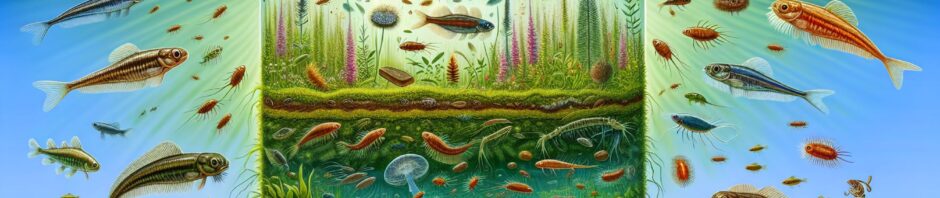
Freshwater ecosystems are more than just tranquil bodies of water – they are complex, dynamic systems teeming with life. Tucked away within these waters lies a group of creatures with a microscopic size but an enormous impact: the Daphnia. Often unseen by the naked eye, these small crustaceans, which are a part of the Cladocera family, play a pivotal role in the health and function of aquatic systems. This article delves into the secretive lives of Daphnia, revealing their significance in water quality, their contribution to food webs, and their unique biological traits that make them indispensable to freshwater habitats.
What Are Daphnia?
Daphnia, commonly called water fleas, are a genus of small, planktonic crustaceans belonging to the order Cladocera. Measuring just 0.2-5 mm in length, these creatures might be diminutive, but they are powerful players in their environments. Daphnia are found across the globe, residing in various freshwater habitats including ponds, lakes, streams, and rivers. They are filter feeders, clearing water of algae and bacteria, which forms their primary diet.
The Biology of Daphnia
Daphnia exhibit some fascinating biological characteristics that set them apart from other aquatic organisms. They possess a transparent carapace that offers a clear view of their inner workings such as their beating heart and developing embryos. Their bodies are teardrop-shaped, which aids their movement through water with a distinctive hopping motion, hence the name water fleas.
Life Cycle and Reproduction
Their lifecycle comprises both asexual and sexual reproduction. Under favorable conditions, Daphnia populations can explode through parthenogenesis, where females produce genetically identical offspring without the involvement of males. However, when environmental conditions sour, they switch to sexual reproduction and produce resting eggs which are encased in protective coverings called ephippia. These eggs can withstand extreme conditions and hatch when situations improve, ensuring the resilience and continuity of Daphnia populations.
Sensitivity to Water Quality
One of Daphnia’s most crucial functions is as biomonitoring agents. Their sensitivity to changes in water quality makes them excellent indicators for ecotoxicological studies (Roy et al., 2012). They respond to various stressors, such as chemical pollutants, with clear-cut behavioral and physiological changes, making them a valuable tool for water quality assessment.
The Importance of Daphnia in Aquatic Ecosystems
Daphnia are central figures in aquatic food webs. They graze on microscopic algae, preventing algal blooms that can lead to disruptive eutrophication. Additionally, they help in nutrient cycling and maintain the balance of dissolved oxygen in water bodies. Furthermore, Daphnia are an essential food source for fish and other predators, supporting the higher trophic levels in the food web.
Daphnia’s Role in Filter Feeding and Nutrient Cycling
As filter feeders, Daphnia consume a vast array of particles in the water, including bacteria, algae, and detritus. They play a pivotal role in nutrient cycling by breaking down and recycling these components back into the ecosystem, which helps sustain other aquatic organisms.
Biomonitoring and Water Quality Indicators
Due to their sensitivity, Daphnia are frequently used in toxicity testing and ecotoxicology – the study of the effects of toxic chemicals on biological organisms, especially at the population and ecosystem levels. They provide insightful information about the presence of harmful substances and overall water health, making them ideal bioindicators for environmental assessment efforts and aquatic ecosystem monitoring.
Daphnia as a Model Organism in Science
Beyond their environmental roles, Daphnia have garnered interest in scientific research. As a model organism, Daphnia provide insights into population dynamics, predator-prey interactions, evolutionary adaptations, and responses to environmental stressors. They are easy to culture, have short generation times, and demonstrate quick responses to both natural and experimental conditions, making them well-suited for laboratory studies.
Insights into Predatory Dynamics
Their interactions with predators have been widely studied to understand predator-prey relationships. Predatory threats can trigger morphological changes in Daphnia, such as the growth of protective spikes, showcasing an immediate evolutionary adaptation to environmental pressures.
Understanding Environmental Stress Responses
Daphnia’s responses to various environmental factors include temperature effects, behavioral responses to dissolved oxygen levels, and coping mechanisms with chemical pollutants. These responses are valuable for understanding how aquatic species can survive and adapt to changing environmental conditions.
Daphnia in the Face of Environmental Change
The study of Daphnia serves as a window into the health of freshwater ecosystems, but it also raises concerns. Global environmental changes – such as the increase in pollutants and the progression of climate change – pose threats to their existence and, by extension, to the intricate balance of freshwater habitats.
Threats from Eutrophication and Algal Blooms
Eutrophication, driven by excessive nutrient input primarily from human activities, can lead to explosive algal growth. While Daphnia feed on algae, they can be overwhelmed by excessive algal blooms, which can diminish Daphnia populations and disrupt the ecological balance.
Impact of Chemical Pollutants
Pesticides, heavy metals, and other toxic substances can accumulate in aquatic systems. Daphnia are particularly susceptible to these pollutants, and declines in their populations can lead to cascading effects throughout the ecosystem.
Climate Change Adaptations and Challenges
Rising temperatures and altered precipitation patterns impact freshwater systems, affecting the habitat and life cycle of Daphnia. Understanding how Daphnia adapt to these changes is crucial to predicting and managing the future health of aquatic environments.
Conclusion
Daphnia, the tiny custodians of freshwater habitats, embody the intricate relationships woven throughout aquatic ecosystems. Their significance in maintaining water quality, their role in the food web, and their responses to environmental stressors make them an indispensable subject of study. By observing and understanding Daphnia, scientists can better gauge the health of aquatic systems and the challenges posed by environmental changes.
As we continue to grapple with ecological issues, the study of Daphnia and their kin grows in importance, bringing to light the invisible threads that tie together life in our waters. It is only by acknowledging and supporting these tiny organisms that we can aspire to preserve the complex mosaic of life that thrives within the world’s freshwater ecosystems.
Sources
- Roy, T., Saha, G., & Zaman, S. (2012). Use of Daphnia spp. for Ecotoxicological Assessment. Journal of Ecotoxicology & Enviromental Monitoring, 22(3-4), 251-255.
- Colbourne, J. K., Pfrender, M. E., Gilbert, D., Thomas, W. K., Tucker, A., Oakley, T. H., … & Lynch, M. (2011). The ecoresponsive genome of Daphnia pulex. Science, 331(6017), 555-561.
- Ebert, D. (2005). Ecology, Epidemiology, and Evolution of Parasitism in Daphnia. National Center for Biotechnology Information, U.S. National Library of Medicine.