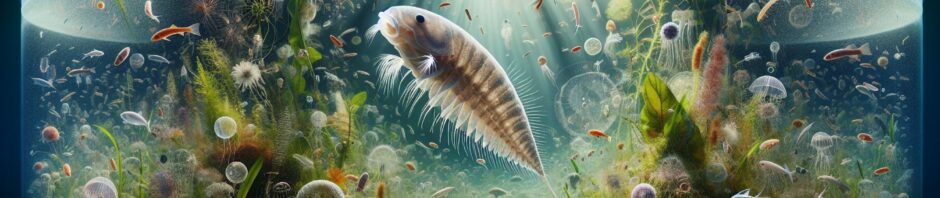
When we peer into the calm waters of a pond or the gentle flows of a stream, we seldom recognize the complex dynamics and delicate balances that sustain aquatic life. Beneath the surface, a myriad of organisms each play a critical role in maintaining the health and stability of these environments. Among them is a group of tiny creatures, whose significance belies their size – Daphnia, often referred to as water fleas.
In this comprehensive article, we dive into the fascinating world of Daphnia, exploring their biology, ecological significance, and the profound impact they have on the assessment and maintenance of water quality. Through this exploration, we gain insights into the intricate webs that bind life in freshwater bodies and our part in protecting these valuable ecosystems.
What is Daphnia?
Daphnia is a genus of small planktonic crustaceans, typically 0.2–5 mm in length. They belong to the order Cladocera and are part of the broader category of zooplankton. Daphnia are found in a variety of freshwater environments from ponds to lakes and can even be located in brackish water. Their common name, “water flea,” comes from their jerky swimming motion, reminiscent of the jumps of land fleas.
Life Cycle and Reproduction
One of the most intriguing aspects of Daphnia biology is their complex life cycle, which includes both sexual and asexual reproduction (parthenogenesis). Under favorable conditions, Daphnia populations can reproduce asexually, with females producing genetically identical offspring. This method of cloning allows for quick population increases.
Nevertheless, when environmental conditions turn harsh, such as a change in temperature, food scarcity, or the accumulation of waste products, Daphnia switch to sexual reproduction. This results in the production of resting eggs, encased within a protective structure called an ephippium. These eggs are incredibly resistant to adverse conditions and can remain dormant for extended periods, ensuring the survival of the species through times of stress.
Daphnia as Filter Feeders
With a diet consisting of algae, bacteria, and other microorganisms, Daphnia play a role as filter feeders in their environments. They are equipped with specialized filtering appendages that enable them to sieve tiny food particles from the water, effectively purifying the water as they feed. This not only aids in their sustenance but also contributes to water clarity and the reduction of algal blooms, a process known as top-down control.
Ecological Roles and Environmental Indicators
Because of their sensitive responses to changes in the environment, Daphnia are paramount as indicators of water quality and are extensively used in ecotoxicology and biomonitoring. Variations in their population dynamics, behavior, and physiology can reflect the presence of chemical pollutants, fluctuations in dissolved oxygen levels, and temperature effects.
Biomonitoring and Water Quality
The biomonitoring use of Daphnia is well-documented. They respond rapidly to a range of contaminants, including heavy metals, pharmaceuticals, and other chemical pollutants. This makes them ideal subjects for toxicity testing, which measures the impact of various substances on their survival, reproduction, and behavior. Agencies and researchers use these responses to assess environmental health and draft regulations to protect water bodies.
Involvement in Trophic Levels and Food Web Dynamics
As primary consumers in aquatic food webs, Daphnia are critical for cycling nutrients and are a vital food source for a variety of predators, including fish, insects, and other invertebrates. They occupy a key position in the energy flow of their habitats, transferring energy from primary producers (like algae) to higher trophic levels.
Furthermore, Daphnia can exhibit complex predator-prey interactions that influence their population dynamics and evolution. For instance, their transparent bodies can accumulate pigments from their algal diet to provide some camouflage against visually hunting predators, an example of an evolutionary adaptation.
Challenges and Threats: The Impact of Human Activity
Human influences, particularly pollution and habitat destruction, pose significant threats to Daphnia populations and, by extension, the freshwater ecosystems they support. Eutrophication – the process by which waters become overly enriched with nutrients, often due to run-off from agriculture and urban areas, can lead to excessive algal growth that outcompetes Daphnia for oxygen and food.
Algal blooms, which can be toxic, reduce water quality and visibility, leading to die-offs of Daphnia and other aquatic species. This, in turn, can destabilize food webs and disrupt the balance of freshwater ecosystems.
Future Prospects and Research
Continued research into the diverse aspects of Daphnia biology and ecology is vital for preserving freshwater biodiversity. Understanding the factors governing their population dynamics and life cycles helps us predict and mitigate the effects of environmental change. Further, the study of their evolutionary adaptations may unlock new solutions for managing and conserving freshwater ecosystems in the face of anthropogenic pressures.
As ongoing studies delve into Daphnia‘s genetic and physiological responses to environmental stressors, we can look forward to gaining deeper insights into not just their world, but also the broader implications for our water resources and global biodiversity.
Conclusion
The significance of Daphnia extends far beyond their diminutive stature; they serve as vital components in the delicate machinery of aquatic ecosystems. Their roles as filter feeders, trophic intermediates, biomonitoring tools, and water quality indicators are indispensable. By understanding and appreciating these complex beings, we can work towards sustainable practices that safeguard their existence, and in turn, our precious freshwater resources.
Sources
- Ebert, D. (2005). Ecology, Epidemiology, and Evolution of Parasitism in Daphnia. Bethesda (MD): National Center for Biotechnology Information (US). Available from: https://www.ncbi.nlm.nih.gov/books/NBK2042/
- Lampert, W. (2011). Daphnia: Model Herbivore, Predator and Prey. Polskie Archiwum Hydrobiologii / Polish Archives of Hydrobiology, 54(3), 607–616.
- Nandini, S., & Sarma, S. S. S. (2019). The Ecology and Evolution of Inducible Defenses in Daphnia: A Review of Models, Theories, and Experiments. Hydrobiologia, 830, 9–29. DOI: 10.1007/s10750-019-3907-6
Using the Markdown format ensures that articles such as this can be translated into HTML for blog publication easily, retaining their structured formatting, headers, and reference lists.