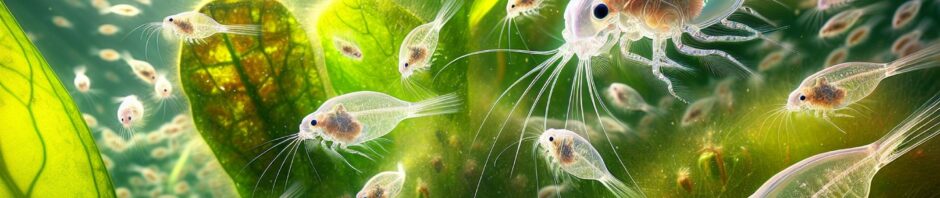
Amid the hustle and bustle of the aquatic world, a group of organisms too small for the human eye to see without assistance plays a massive role in the health and sustainability of freshwater ecosystems. Among these, Daphnia, a genus of small planktonic crustaceans, earn their rightful spot at the forefront of ecological research and environmental monitoring. The following article delves into the world of Daphnia, exploring their unique biology, ecological importance, and their role in biomonitoring and ecotoxicology.
The Biology of Daphnia: An Overview
Daphnia, colloquially known as water fleas, belong to the order Cladocera. While they are small—usually between 0.2 to 5 mm in length—they are mighty in ecological importance. These aquatic invertebrates are easily recognized by their transparent exoskeleton and jerky, hopping movement through the water, which is caused by the beating of their leaf-like legs.
Life Cycle and Reproduction
Daphnia have a fascinating life cycle that includes both asexual (parthenogenesis) and sexual reproduction. During favorable conditions, such as abundant food supply and ideal temperatures, females reproduce asexually, producing genetically identical clones. This ability allows for rapid population growth and exploitation of available resources.
As environmental conditions worsen or seasons change, triggering cues such as shorter day lengths and colder temperatures, Daphnia switch to sexual reproduction. They produce resting eggs, which are encased in a structure called an ephippium. These ephippia ensure the survival of genetic material through harsh conditions and can hatch when favorable circumstances return.
Feeding and Trophic Position
Daphnia are filter feeders, using their specialized appendages to sieve particles—including algae, bacteria, and detritus—from the water. Their position in the food web is crucial; they serve as a primary consumer, directly ingesting primary producers (e.g., phytoplankton) and in turn, becoming a food source for higher trophic levels including fish and invertebrate predators. Consequently, they effectively transfer energy and nutrients up the food web.
Ecological Significance
Biomonitoring and Water Quality Indicators
Due to their sensitivity to changes in their environment, Daphnia are prime candidates for biomonitoring—the use of biological responses to assess environmental conditions, particularly the presence of chemical pollutants. Their quick generational turnover and the visibility of their internal organs through their transparent carapace allow researchers to observe physiological changes, reproductive effects, and even behavioral responses to contaminants.
Numerous scientific studies utilize Daphnia to evaluate the toxicity of substances, which can be crucial in establishing water quality standards and regulations. Because they respond predictably to pollutants and environmental stressors, Daphnia can act as early-warning indicators, signaling the potential for broader ecological impacts.
Eutrophication and Algal Blooms
Algal blooms, often resulting from eutrophication—a process driven by excess nutrients (particularly nitrogen and phosphorus) in water bodies—can severely disrupt aquatic ecosystems. Daphnia play a role in mitigating these blooms through their consumption of algae. Their grazing activities can help maintain algae populations at levels that do not compromise water quality or lead to the suffocation of aquatic life due to depleted dissolved oxygen.
Nutrient Cycling and Dissolved Oxygen
In their role as filter feeders, Daphnia contribute to nutrient cycling within aquatic ecosystems. By feeding on particulates and excreting waste, they participate in the transformation and movement of nutrients such as carbon, nitrogen, and phosphorus. Moreover, their feeding activities help to maintain higher levels of dissolved oxygen in the water by promoting the decomposition of organic material, which otherwise would consume oxygen as it decays.
Impacts of Environmental Changes
Predator-Prey Interactions
The interactions between Daphnia and their predators are complex and significant for population dynamics within aquatic ecosystems. Daphnia have evolved numerous defense mechanisms, including changes in size, reproduction rate, and even the development of protective spines, to evade predation. Predators, in turn, have evolved various strategies to overcome these defenses, leading to a dynamic balance that shapes community structure and function.
Temperature Effects and Climate Change
Temperature plays a pivotal role in the life cycle and distribution of Daphnia. They generally flourish in colder environments, and rising global temperatures due to climate change could impact their survival and reproductive patterns. As temperature affects metabolic rates and oxygen solubility in water, a warming climate presents a threat to Daphnia populations and, by extension, the ecosystems they support.
Chemical Pollutants and Behavioral Responses
Daphnia are known to exhibit an array of behavioral responses to chemical pollutants, such as avoidance of contaminated areas and reduced feeding. These alterations in behavior can have cascading effects on population dynamics and ecosystem health. For instance, the avoidance of certain zones can result in uneven grazing pressure, leading to localized algal blooms and potentially affecting nutrient cycling.
Daphnia in Ecotoxicology and Environmental Assessment
Ecotoxicology is the study of the effects of toxic chemicals on biological organisms, particularly in relation to their impact on populations, communities, and ecosystems. Daphnia are a cornerstone species for ecotoxicological studies due to their aforementioned characteristics.
Multiple standardized tests, such as the Daphnia acute toxicity test, have been developed to measure the impact of chemical substances on Daphnia. These tests often provide information that is extrapolated to predict potential risks to human health and the environment, underscoring the importance of this tiny organism in evaluating anthropogenic impacts on aquatic ecosystems.
Conclusion
Daphnia may be small, but their role within freshwater habitats is immense. They serve as an essential link in food webs, contribute to nutrient cycling, and are a key player in maintaining water quality. Their prolific use in biomonitoring and ecotoxicology highlights their significance as sentinels of environmental health. As research continues to uncover the facets of their existence and adaptability, Daphnia will remain a central figure in our attempts to understand, protect, and sustain the delicate balance of freshwater ecosystems.
Sources
- Ebert, D. (2005). Ecology, Epidemiology, and Evolution of Parasitism in Daphnia. Bethesda (MD): National Library of Medicine (US), National Center for Biotechnology Information.
- Lampert, W. (2011). “Daphnia: Model Herbivore, Predator and Prey.” Polar Biology, 34(6), 171-183.
- Organisation for Economic Co-operation and Development (OECD). (2004). Daphnia sp. Acute Immobilisation Test. OECD Guidelines for the Testing of Chemicals, Section 2.