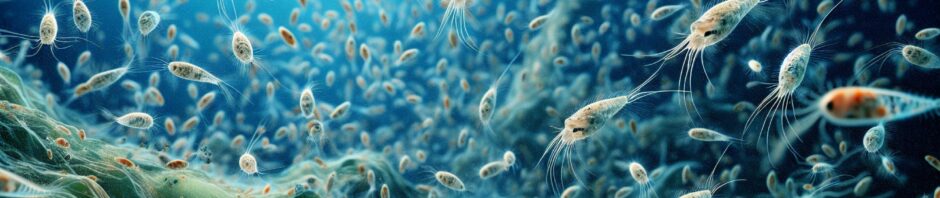
Hello, everyone! Today, I get to shed some light on some descendants of ‘Titans of the Deep,’ whose existence dates back about 3.5 billion years! They’re not gigantic, they’re not scary, and, in fact, they’re almost invisible to the naked human eye. Enter the wonderful world of Zooplankton!
Although they may seem minuscule and insignificant, these tiny creatures provide vital functions in aquatic ecosystems.
What are Zooplankton?
Zooplankton, in simple terms, are small organisms that float in our planet’s oceans, seas, and bodies of freshwater. The term derives from the Greek words “zoon” meaning animal and “planktos” meaning wanderer or drifter [^1^]. They are a mesmerizing mix of tiny animals, such as crustaceans and mollusks, as well as the juvenile stages of larger species like fish and jellyfish.
The Role of Zooplankton
Despite their microscopic size, zooplankton are one of the foundations of the aquatic food web. They serve as the all-important bridge between the primary producers (phytoplankton and algae) and the larger animals that feast on them. Zooplankton are filter feeders, which means they gorge themselves on tiny, microscopic organisms [^2^].
Also, through their feeding and waste, zooplankton contribute significantly to nutrient cycling, promoting the movement of energy and nutrients from one trophic level to the other.
Zooplankton also play a vital role in biogeochemical cycles. They aid in carbon sequestration, meaning they consume carbon during feeding and transport it to deeper water levels when they die and sink.
Different Types of Zooplankton
Zooplankton can broadly be classified into two main types: the meroplankton (temporary plankton) and the holoplankton (permanent plankton). Meroplankton includes organisms like tadpoles and bristle worms, which spend only a part of their life cycle as plankton. On the other hand, Holoplankton, like the popular Daphnia, spend their entire lives as drifting members of this community.
Life Cycle and Reproduction
The fascinating reproductive strategies of zooplankton, especially the Daphnia, need to be talked about. Daphnia reproduce asexually through a process known as parthenogenesis. When environmental conditions deteriorate or food becomes scarce, they switch to sexual reproduction and produce resistant “resting eggs” enclosed in a shell called an ephippium. This strategy ensures the survival of the next generation when conditions are favorable again [^3^].
Zooplankton as Water Quality Indicators
One critical ecological role of zooplankton includes biomonitoring. Changes in the diversity and population of zooplankton often signal changes in water quality. Moreover, they help in toxicity testing by helping us understand the impact of various chemical pollutants. Zooplankton can therefore serve as powerful bioindicators, alerting us to the health of our waters.
Continual research in ecotoxicology, studying the effects of toxic chemicals on zooplankton, leads us to comprehend the larger implications for the ecosystem and develop strategies to counter pollution.
To Sum Up
Zooplankton may be small, but their ecological significance is colossal. They help clarify the bigger picture: each creature, no matter how tiny, has a crucial role in maintaining the planet’s health. Next time you admire a beautiful body of water, remember that an army of tiny wanderers is working beneath the surface, maintaining balance and harmony in the aquatic world.
Let’s continue to learn about, appreciate, and protect these tiny organisms that form a lifeline of aquatic ecosystems.
Celebrate Zooplankton, the tiny titans of our lakes, rivers, and oceans!
Sources:
[^1^] Oceanic Institute. (n.d.). What is Zooplankton?. [Online] Available at: https://www.oceanicinstitute.org/aboutoceans/aquafacts/zooplankton.html
[^2^] National Geographic Society. (2012). Zooplankton. [Online] Available at: https://www.nationalgeographic.org/encyclopedia/zooplankton/
[^3^] Bern, University of. (2017). The life cycle of Daphnia. [Online] Available at: https://www.daphnia.ecology.orn.mpg.de/research/DaphniaLifeCycle.html
Always curious, always learning.
Catch you in the next blog, mates!”