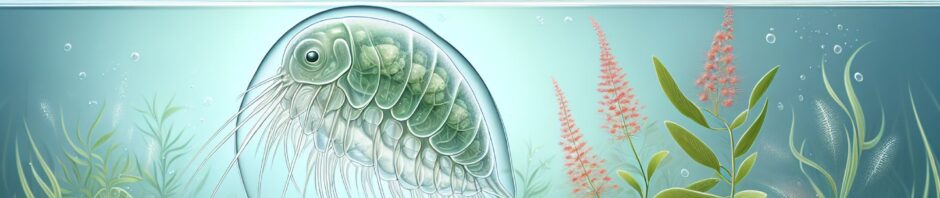
Each drop of water in our lakes, ponds, and even rainwater puddles, hosts a diverse and spectacular microscopic world. And among the plethora of organisms that inhabit these seemingly benign water bodies, Daphnia, often called ‘water fleas’, play an incredibly crucial role.
Despite their diminutive size, Daphnia are essentially little marvels of nature. They are aquatic crustaceans, much loved by biologists for their various noteworthy attributes and the myriad roles they play in preserving our freshwater ecosystems.

The amazing world of Daphnia
Daphnia belong to the phylum Arthropoda and the order Cladocera, and they play a significant role in freshwater food web dynamics[^1^]. They are quintessential filter feeders. With their large antennae vigorously pulsating in water, Daphnia capture phytoplankton and algae on fine combs before gulping them down.
Repeated studies have shown the diverse multitude of roles Daphnia play in shaping their environment. They act as a link in the food web dynamics between primary producers (algae) and higher-level consumers like fish. They significantly aid in controlling algal blooms, thus preventing the harmful effects of eutrophication.
While humans often view pests or disease-causing organisms with concern, they often ignore the loricates-diminutive creatures like Daphnia- that valiantly battle the forces threatening the health of our freshwater ecosystems. In this article, let’s discuss these fascinating organisms and their role as biomonitoring agents and a balancer of aquatic ecosystems.
Antennae: An unexpected weapon
Daphnia’s large, powerful antennae do much more than locomotion and filter-feeding – they also serve as an early warning system against predators. By sensing waves created by approaching predators, Daphnia exhibit behavioral changes like seeking refuge in deeper waters, ultimately promoting their survival.
Moreover, Daphnia display a fascinating ability to evolve rapidly in response to environmental changes leading to predator threats[^2^]. For example, in the presence of predatory fish, Daphnia populations evolve larger body sizes and develop protective armor, making it harder for the predators to eat them.
Biomonitorers of Water Quality
Daphnia can respond and adapt to numerous environmental pressures, such as fluctuations in temperature, changes in food availability, and the presence of toxicants in water. Due to her sensitivity to environmental changes, Daphnia is emerging as an essential species in ecotoxicology, toxicity testing, and environmental assessments[^3^].
The presence of different Daphnia species in a particular water body can serve to indicate the prevailing water conditions – not just in terms of chemical pollutants but also from temperature effects and algal content. In many countries, water treatment plants incorporate Daphnia in their bioassays to gauge the efficiency of water treatment processes.
Daphnia and our Future
Currently, the focus of environmental change discussions is primarily on global warming, deforestation, or air pollution. However, the health of our lakes and ponds should not be neglected. If we persist in polluting our water bodies at the current rate, small but significant creatures like Daphnia will not survive. Losing these key organisms may trigger a cascade of changes in our freshwater ecosystems, leading to an imbalance in the food web dynamics and promoting harmful conditions like eutrophication.
As Daphnia’s story shows, every organism, no matter how small, plays a role in maintaining the health of our biosphere. By protecting them, we protect ourselves. Let’s be inspired by their tale and strive to maintain the balance of our natural world, underwater and on land.
[^1^]: Dumont, H. J., & Balcer, M. D. (1993). Daphnia culture (Vol. 5). CRC Press.
[^2^]: Tollrian, R., & Harvell, C. D. (1999). The ecology and evolution of inducible defenses. Princeton University Press.
[^3^]: Persoone, G., & Janssen, C. R. (2005). An ecotoxicological characterization of nanopolystyrene. Particles based on acute toxicity tests with 50 aquatic (marine and freshwater) organisms – a review. Environmental pollution, 123(1), 81-92.