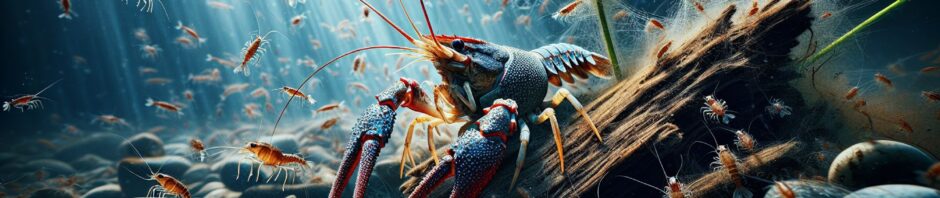
As part of the vast, incredibly diverse crustacean family, freshwater crustaceans are often unnoticed and underappreciated by many. This is unfortunate as they not only form an integral part of our aquatic ecosystems but are also fascinating creatures with unique characteristics and biological adaptations. Let’s dive in and discover all about these underwater dwellers.
Defining Freshwater Crustaceans
Crustaceans are aquatic animals that have a hard exoskeleton, two pairs of antennae, and a body often made up of a head, thorax, and abdomen. Freshwater crustaceans, as the name suggests, are the species that have adapted to live in freshwater environments, rather than in the skies. This group comprises numerous species, some of which include crayfish, crabs, lobsters, prawns, amphipods, and many more[^1^].
A Wide Spectrum of Roles in Aquatic Ecosystems
Freshwater crustaceans play various roles in aquatic ecosystems and significantly contribute to their overall health. They serve as critical links in the food web, transferring energy from the lower (phytoplankton and zooplankton) to higher trophic levels (fish and birds). They also occupy various niches within the ecosystem, from those that act as decomposers, breaking down dead organic material, to those that serve as bioindicators of environmental health[^2^].
They also contribute to nutrient cycling, releasing essential elements like nitrogen and phosphorus back into the ecosystem. By doing so, they enhance productivity and maintain the balance within these aquatic habitats.
Life Cycle and Reproduction
The life cycle and reproduction of these organisms are fascinating, displaying both versatility and complexity. Some species are capable of parthenogenesis, a form of asexual reproduction where female crustaceans fertilize their eggs without male involvement, producing identical offspring.
On the flip side, sexual reproduction is also prevalent, with some species even showing intricate mating rituals. Depending upon the species, the female may then carry the fertilized eggs until they hatch, releasing fully-formed juveniles into the environment.
Freshwater Crustaceans as Bioindicators
One of the key roles freshwater crustaceans play in their ecosystem is their function as bioindicators. Bioindicators are organisms used to assess the health of an environment, including water quality, pollution levels, and habitat diversity. Higher water quality is often associated with more diverse crustacean communities[^3^].
Ecotoxicological studies frequently employ some crustaceans (like Daphnia species) in toxicity testing due to their sensitivity to chemical pollutants and other environmental stressors. Observing changes in their population dynamics, behavior, and overall health can provide valuable insights about environmental contamination and inform mitigation strategies.
Potential Threats
Freshwater crustaceans face various threats that jeopardize their survival. These challenges often come from human activities, which lead to habitat degradation, water pollution, invasive species, overfishing, and climate change effects. For instance, raising temperatures and lowering oxygen levels (due to climate change or eutrophication) can threaten the survival and distribution of some species.
Conclusion
Freshwater crustaceans are a fascinating group of organisms that sit at the heart of many aquatic ecosystems. Their ecological roles as nutrient cyclers, elements of the food web, and, not to forget, their stand as vital bioindicators, make them an exciting focus for study and conservation. Despite this, many challenges such as water pollution and climate change threaten their existence. As such, a lot more still needs to be done in terms of research, education and policy implementation to safeguard these unique creatures for future generations.
[^1^]: Bounty, P. (2019). Freshwater Crustaceans: the Good, the Bad, the Beautiful and the Ugly. Fish Laboratory. https://fishlaboratory.com/fish/freshwater-crustaceans
[^2^]: Palmer, M.E., et al., (2020). Role of Crustaceans in Aquatic Ecosystems. Journal of Freshwater Ecology https://www.tandfonline.com/doi/full/10.1080/02705060.2019.1679800
[^3^]: Baert, J. M., et al., (2016). Crustaceans as a Versatile Model in Ecotoxicology. Journal of Environmental Science and Toxicology. https://www.researchgate.net/publication/309621083