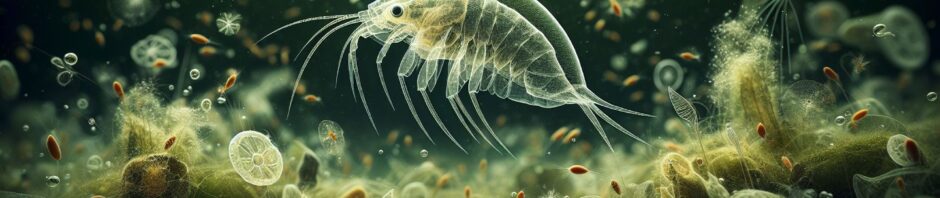
Nature has an extraordinary way of maintaining balance. In freshwater ecosystems, one of the secretive superheroes helping to keep things harmonious is a creature known as Daphnia, also known as water fleas. Daphnia are small freshwater planktonic crustaceans, barely visible to the naked eye. They belong to the order Cladocera, and their appearance is marked by their transparent exoskeleton and a distinctive ‘crown’ of hairs they use for filter-feeding[^1^].
Life Cycle and Reproduction
Daphnia is an example of an organism that is able to conduct both other forms of reproduction: parthenogenesis (asexual reproduction) and sexual reproduction. In warm weather (spring and summer), female daphnia reproduce asexually, producing genetically identical offspring. When environmental conditions become less favorable (often in autumn or when food is scarce), daphnia switch to sexual reproduction. The fertilized eggs are then placed in a protective case called an ephippium, which helps the species withstand harsh conditions until suitable conditions return[^1^].
Role in Trophic Levels and the Food Web
In the trophic levels of a food web, Daphnia occupy an essential spot. They feed primarily on algae (phytoplankton), using their crown of hairs to filter the water and consume these microscopic plants. This makes them primary consumers and a crucial link between the primary producers (algae and other plants) and the other trophic levels. In turn, Daphnia serves as a protein-rich meal for a variety of predators, such as fish and amphibians[^2^].
Behavioural Responses and Evolutionary Adaptations
Daphnia have several remarkable evolutionary adaptations that allow them to survive and thrive. They are noted for their ability to respond to changes in their environment, such as variations in food quantity, quality, and presence of predators. A reflective ‘eye’ and a rapid jumping motion via beating of their second antennae help evade predators[^3^]. Individuals from populations which are frequently exposed to predators often exhibit protective traits such as larger body size and lengthened spines[^3^].
Daphnia as Water Quality Indicators and Bio-monitors
Perhaps one of the most vital roles that Daphnia play is that of bio-indicators and biomonitors. Their populations can provide valuable insights into the health of a freshwater ecosystem. Factors such as dissolved oxygen, chemical pollutants, algal blooms, and nutrient levels can significantly influence the population dynamics of Daphnia.
Changes in the abundance, distribution, or species composition of Daphnia can reflect alterations in water quality and serve as an early warning sign of environmental stress or degradation. And because these little creatures quickly reproduce, observing their population dynamics can give a real-time snapshot of ecotoxixity[^4^].
Conclusion
Despite their unassuming size, Daphnia play a significant role in shaping freshwater ecosystems. They help sustain a balance by serving as a key link in the food chain, contribute to the cycling of nutrients, and act as indicators of ecological health. Their importance underlines why it is crucial for scientists, conservationists, and we, as empathetic humans, should strive to understand and protect these tiny creatures and the waters they call home.
So, next time you’re by a pond or a lake, don’t forget to appreciate this microscopic marvel that bustles beneath the surface. The humble Daphnia, a tiny organism with a colossal role to play in our world.
Adapt or perish, now as ever, is nature’s inexorable imperative. – H. G. Wells
[^1^]: Daphnia: An Aquatic Model System
[^2^]: The Role of Daphnia in Aquatic Food Webs
[^3^]: Daphnia Behavioural Responses and Evolutionary Adaptations
[^4^]: Bio-Indicators and Bio-Monitors by Daphnia