By: [Your Name]
There’s an entire microscopic world pulsating with life beneath the surfaces of ponds, lakes, and oceans, largely unnoticed by the naked eye. This underwater universe is teeming with an amazing class of organisms called Zooplankton. Though small in size, they play a huge role in marine biology and have profound impacts on our planet’s ecology.

Definition
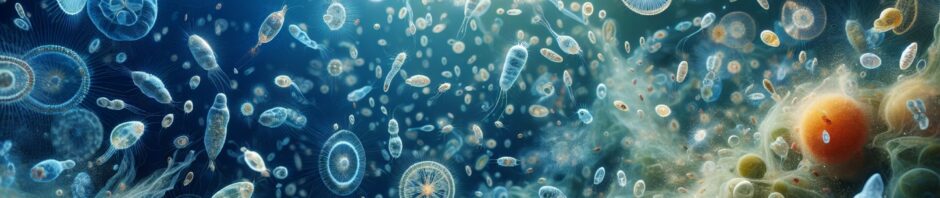
Zooplankton are a diverse group of minuscule organisms that float in the world’s oceans, seas, and bodies of fresh water. They include various species of tiny animals, larvae, and even microscopic juvenile stages of larger animals such as mollusks and fish. They inhabit the water column and largely depend on water currents for movement because of their small size and weak swimming ability[^1^].
Zooplankton is derived from the Greek word “zōon,” meaning “animal,” and “planktos,” meaning “wanderer” or “drifter.” And it suits them perfectly – these tiny drifters wander across miles of water, carried along by currents, waves, and tides.
Types of Zooplankton
Zooplankton can be broadly classified into two main categories: holoplankton and meroplankton. Holoplankton comprises species that are planktonic throughout their entire lives. Examples include copepods, krill, and Cladocera. On the other hand, meroplankton consists of organisms that are only planktonic for a portion of their lives (usually the larval stage), after which they grow into larger, non-planktonic organisms. Sea stars, crustaceans, and most fish start their lives as meroplankton[^2^].
The Role of Zooplankton in the Aquatic Food Web
Despite being tiny, zooplankton are the bedrock that supports aquatic food web dynamics. Being primary consumers who feed on phytoplankton (microscopic plant-like organisms), they become an irreplaceable food source for an array of secondary consumers like small fish, jellyfish, and other larger zooplankton.
Subsequently, these secondary consumers are then consumed by tertiary consumers like larger fish and marine mammals. This feeding chain, or trophic levels, illustrates the crucial role zooplankton play in nutrient cycling, effectively transferring energy from the primary producers (phytoplankton) to higher order consumers.

Zooplankton and the Environment
Zooplankton are not just any marine organisms, they’re staunch environmental informants. Due to their rapid response to environmental changes and sensitivity to various pollutants, they serve as excellent water quality indicators. The diversity and population dynamics of zooplankton can signal the health of their environment – a decline may indicate increased pollution or climate change impacts, while a rapid increase might suggest an unsustainable algal bloom.
Moreover, zooplankton play an assisting role in mitigating climate change. When they consume carbon-rich food on the water surface and excrete it as they sink, they transfer carbon to deeper waters. This behavioral response called the ‘biological pump’ contributes significantly to the sequestration of carbon dioxide[^3^].
Conclusion
Zooplankton might be small, but they are titanic influencers in marine ecosystems. From forming the backbone of the aquatic food web to being the marine ecosystem’s sentinels, these tiny drifters are vital for the health and function of our planet. They are a vivid demonstration of the fact that size doesn’t determine significance, and in the world of water, even the smallest organism can have the most crucial role.
However, threats like climate change, marine pollution, and unsustainable fishing pose significant challenges to their survival. It’s essential to understand and respect their role in maintaining the ecological balance of our oceans and take proactive measures to protect these minuscule, yet mighty creatures.
Sources:
[^1^]: National Geographic, Zooplankton
[^2^]: NOAA Ocean Facts, What is Zooplankton?
[^3^]: Nature Education, The Role of Zooplankton in the Biological Carbon Pump