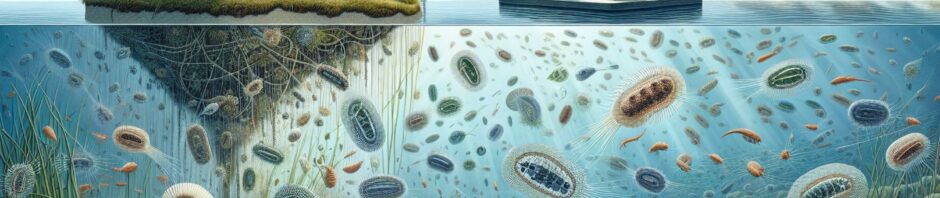
Daphnia, otherwise known as water fleas, are small planktonic crustaceans found in a variety of freshwater environments. As an integral part of aquatic ecosystems, these tiny organisms play an outsized role in nutrient cycling, trophic dynamics, and biomonitoring. This article will explore the biology and ecology of Daphnia, focusing on their life cycle, the importance they hold in freshwater habitats, and their application in environmental assessments through biomonitoring and toxicity testing.
Understanding Daphnia and Their Environment
Daphnia belong to the group of aquatic invertebrates known as Cladocera. Found globally in a range of freshwater environments, these filter feeders are a critical component of zooplankton, which constitutes an essential link in aquatic food webs.
Life Cycle and Reproduction
Daphnia exhibit complex life cycles characterized by a mix of asexual reproduction (parthenogenesis) and sexual reproduction. During favorable conditions, Daphnia reproduce asexually, with females producing clones of themselves that develop from unfertilized eggs. This mode of reproduction enables rapid population growth and can lead to the formation of sizeable Daphnia swarms in nutrient-rich waters.
Occasionally, environmental cues such as a change in temperature, food scarcity, or an increase in population density trigger Daphnia to produce males and engage in sexual reproduction. This process results in the creation of tough, dormant eggs known as ephippia, which can survive harsh conditions, such as freezing or drying, allowing Daphnia to persist through adverse periods.
Adaptive Strategies and Evolutionary Significance
Daphnia have evolved to cope with various environmental challenges. They exhibit a range of behavioral responses to predators by altering their swimming patterns or depth during different times of day, effectively avoiding predation. Such evolutionary adaptations have positioned Daphnia as a focal point in studies on predator-prey interactions and population dynamics.
Daphnia’s Role in Aquatic Ecosystems
Daphnia’s prominence in freshwater ecosystems goes beyond their survival tactics. They are central to several ecological processes, such as nutrient cycling, food web dynamics, and maintaining water quality.
Trophic Levels and Food Web Dynamics
As filter feeders, Daphnia consume small particles, including bacteria, detritus, and particularly algae. By controlling algal populations, these micro-crustaceans can curb the development of harmful algal blooms, which are often associated with eutrophication and can lead to depleted oxygen levels in water bodies.
Daphnia themselves serve as a primary food source for many freshwater predators, such as fish and invertebrates, linking the lower trophic levels with higher ones. Their reproductive strategies enable rapid population recovery, ensuring a consistent food supply for higher trophic levels.
Nutrient Cycling and Oxygen Levels
The metabolism and excretion of Daphnia contribute to nutrient cycling by recycling nitrogen and phosphorus, which can then be used by primary producers like algae and plants. Furthermore, their feeding activity aids in the mixing of water layers, promoting the distribution of dissolved oxygen—a critical component of healthy aquatic environments.
Biomonitoring and Environmental Assessment
Perhaps one of the most noteworthy applications of Daphnia is their role in biomonitoring and environmental assessment. Due to their sensitivity to various environmental stressors, including chemical pollutants and changes in temperature, Daphnia are used as bioindicators to assess the health of freshwater systems.
Water Quality Indicators and Toxicity Testing
Daphnia are sensitive to changes in water quality, making them effective water quality indicators. Their behavioral responses and mortality rates can highlight the presence of toxic substances, leading to prompt investigation and remediation measures. Additionally, Daphnia are a common choice in standardized toxicity testing due to their ease of culture and the rapidity with which they exhibit signs of stress.
Ecotoxicology and Environmental Regulations
Studies on Daphnia contribute to the field of ecotoxicology—understanding the effects of toxic substances on ecosystems. Daphnia-based assessments inform environmental regulations, such as the permissible levels of certain contaminants in water bodies. They also help to elucidate the mechanisms by which pollutants exert their toxic effect, further aiding conservation efforts.
Challenges and Future Directions
Despite their resilience, Daphnia populations face threats from habitat loss, climate change, and pollution. Understanding the complex interactions between Daphnia and their environment is vital for their conservation and the overall health of freshwater ecosystems. Research continues to explore aspects such as:
- The impacts of climate change on Daphnia populations
- The long-term implications of chemical pollutants on Daphnia and their ecosystems
- How genetic diversity among Daphnia populations influences their resilience
Through ongoing study and monitoring, the humble Daphnia remains at the forefront of aquatic research, continuing to shed light on the intricacies of freshwater ecosystems.
Sources:
- Lampert, W. (2006). Daphnia: development of a model organism in ecology and evolution. Excellence in Ecology Books. https://www.int-res.com/abstracts/ee/v21/
- Environmental Protection Agency. (2020). Aquatic life ambient freshwater quality criteria – Copper. Science and Technology. https://www.epa.gov/wqc/aquatic-life-ambient-water-quality-criteria-copper-2020
- Colbourne, J.K., et al. (2011). The Ecoresponsive Genome of Daphnia pulex. Science, 331(6017), 555-561. DOI: 10.1126/science.1197761