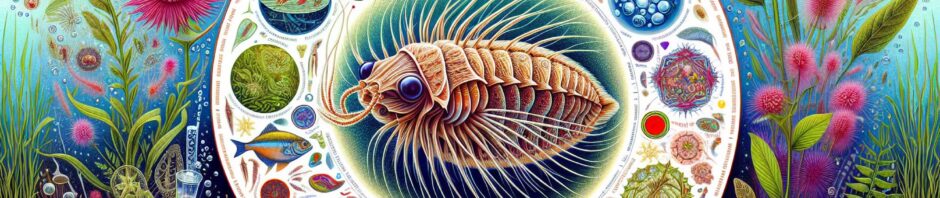
Water is often referred to as the elixir of life. It is the nurturing cradle for a myriad of species and ecosystems. Among its countless inhabitants, a group of small organisms play a monumental role in the health of freshwater habitats and the broader environment. These are the Daphnia, commonly known as water fleas. They may be tiny, but their impact on aquatic ecosystems, their use in scientific research, and their role in environmental assessment are immense.
Understanding Daphnia
Daphnia belong to a class of organisms called Cladocera, which are a subset of the broader group known as aquatic invertebrates. These organisms fall within the zooplankton category – the small and often microscopic creatures that drift in the upper sunlit zones of water bodies. They are integral to the food web dynamics, acting as a key food source for fish and other predators.
The Biology of Daphnia
Daphnia have a distinct, typically oval-shape body enclosed in a transparent carapace made of chitin and bearing a pronounced head. They range in size from 0.2 to 5 mm, which makes them visible to the naked eye as floating specks in water when observed en masse. Daphnia have large compound eyes, an attribute that gives them an excellent response to changes in light and motion, which is crucial for evading predators.
One of the fascinating aspects of their life cycle is that they exhibit both parthenogenesis (a form of asexual reproduction) and sexual reproduction. During favorable conditions, Daphnia reproduce asexually, which allows for rapid population growth. This mode of reproduction produces female offspring that are genetically identical clones of their mothers. However, when environmental conditions deteriorate—such as changes in temperature, food scarcity, or an increase in predator density—Daphnia switch to sexual reproduction, producing eggs that are enclosed in a protective case known as an ephippium. These eggs can withstand harsh conditions and hatch when the environment becomes favorable again.
Ecological Importance of Daphnia
As filter feeders, Daphnia play a significant role in nutrient cycling and the clarity of water bodies. They feed on particulate matter including algae and bacteria by filtering water through specialized feeding appendages. This feeding behavior not only sustains the Daphnia populations but also controls algal blooms, which can lead to eutrophication if left unchecked.
Moreover, their position on the lower trophic levels means they are a crucial link between primary producers (like algae) and higher trophic levels in aquatic ecosystems, such as fish and amphibians. The population dynamics of Daphnia are, therefore, deeply intertwined with predator-prey interactions, offering insights into ecological stability and changes.
Application in Science and Environmental Assessment
Daphnia have become a staple in scientific research due to their rapid life cycle and reproductive flexibility. They are used extensively in ecotoxicology, the study of the effects of toxic chemicals on biological organisms, especially on population, community, ecological, and ecosystem levels. Since they are sensitive to various chemical pollutants, they serve as excellent indicator species for water quality and are commonly used in toxicity testing and biomonitoring. The responses of Daphnia populations to different stressors can provide early warning signs of environmental degradation.
Environmental Assessment and Biomonitoring
In environmental assessment, biologists use Daphnia and other aquatic invertebrates to gauge the health of aquatic ecosystems. They examine the capacity of these organisms to survive, reproduce, and maintain population levels in the presence of pollutants. Daphnia are sensitive to changes in dissolved oxygen, pH levels, temperature effects, and the presence of chemical pollutants. These aspects make them reliable water quality indicators.
The Challenges Faced by Daphnia
Yet, despite their resilience, Daphnia face threats from environmental disturbances such as habitat loss, pollution, and climate change. Their behavioral responses and evolutionary adaptations to these challenges provide rich fields of study but also underscore the fragility of aquatic ecosystems.
Temperature fluctuations, in particular, can greatly affect Daphnia populations. Warmer temperatures accelerate their metabolism, leading to increased feeding rates and faster growth, but also shorter lifespans and heightened vulnerability to predators. While Daphnia exhibit evolutionary adaptations to cope with environmental pressures, the rapid pace of climate change poses serious risks to their survival.
Increasing nutrient loads in water bodies from agricultural runoff and sewage can lead to eutrophication, where excessive nutrients lead to dense algal blooms. While Daphnia populations might initially surge due to increased food availability, the eventual depletion of dissolved oxygen from decaying algal biomass can cause mass mortality events, demonstrably impacting aquatic food webs.
The Impact of Algal Blooms
Algal blooms, often a result of eutrophication, pose a double-edged sword for Daphnia. On one hand, algae serve as their primary food source. On the other, blooms can reduce water quality drastically, often leading to anoxic conditions which can be deadly for Daphnia and other aquatic life forms. Furthermore, some algae produce toxins that can be harmful to Daphnia populations, leading to a decline in their numbers, which in turn affects those species that rely on them as a staple in their diets.
In some cases, Daphnia have been observed to develop defensive strategies and behavioral responses to avoid or tolerate toxins produced by certain algae. These responses are of great interest to researchers who study the complex interactions between aquatic organisms and their environments.
The Role of Daphnia in Education and Research
Beyond their ecological importance, Daphnia are widely used as model organisms in educational settings due to their relatively simple anatomy, translucent bodies, and easily observable physiological processes like heartbeats and blood flow. In research, their role extends to studies on genetic variation, evolutionary biology, and even the effects of pharmaceuticals on ecosystems.
Conclusion
The world of Daphnia may be tiny, but its implications are monumental. These minor actors play a leading role in shaping the quality and health of freshwater ecosystems worldwide. As researchers and environmentalists turn their gaze towards these diminutive creatures, the insights gleaned from their behavior, physiology, and interactions hold valuable lessons about the state of our aquatic habitats and the intricate balance of life that sustains them.
In-depth studies and conservation efforts aimed at understanding and protecting Daphnia, along with their habitats, are essential steps in preserving biodiversity and the natural processes that underpin healthy ecosystems. By safeguarding these miniature custodians of water health, we inherently invest in the future of our planet’s fresh waters and the extensive web of life they harbor.
Sources
- Ebert, D. (2005). Ecology, Epidemiology, and Evolution of Parasitism in Daphnia. Bethesda (MD): National Library of Medicine (US). https://www.ncbi.nlm.nih.gov/books/NBK2036/
- Lampert, W. (2011). Daphnia: Development of a Model Organism in Ecology and Evolution. Oldendorf/Luhe, Germany: International Ecology Institute.
- Colbourne, J. K., et al. (2011). The ecoresponsive genome of Daphnia pulex. Science, 331(6017), 555-