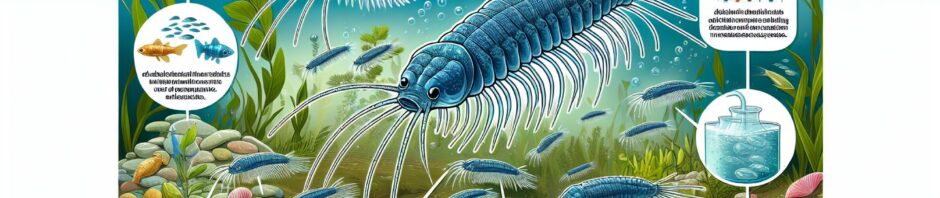
Freshwater ecosystems are complex networks composed of a variety of plants and animals, each playing a critical role in maintaining the delicate balance of life within their environment. Among these creatures, aquatic invertebrates form a large and essential group, contributing significantly to the health, stability, and productivity of aquatic habitats. One notable member of this group is Daphnia, often referred to as “water fleas.” This microscopic freshwater crustacean is invaluable in understanding and preserving freshwater systems, due in part to its role in trophic levels, response to environmental changes, and use in biomonitoring and ecotoxicology.
Understanding Daphnia: An Overview
Daphnia is a small planktonic crustacean belonging to the order Cladocera and is found in an array of freshwater bodies, from ponds and lakes to slow-moving rivers. They are filter feeders, consuming algae, bacteria, and other small particles in the water. Their transparent exoskeleton allows for easy observation of internal structures, making them a favorite subject in biological research and education.
Daphnia and Water Quality Indicators
One of the most crucial roles of Daphnia in the study of aquatic environments is as water quality indicators. As filter feeders, they are sensitive to changes in the water chemistry, making them excellent indicators of ecosystem health.
Biomonitoring Through Daphnia
Biomonitoring involves using living organisms to assess the quality of an environment, particularly to detect changes caused by pollutants or other factors. Daphnia has been widely used in biomonitoring due to its sensitivity to toxic substances. The presence and health of Daphnia populations can provide early warnings of deteriorating water quality and help identify the presence of harmful substances. Researchers have identified distinct behavioral responses and life cycle changes in Daphnia when exposed to different chemical pollutants, providing valuable information for environmental assessment.
Daphnia in Toxicity Testing and Ecotoxicology
Ecotoxicology is the scientific study of the effects of toxic substances on biological organisms, especially at the population, community, ecosystem levels. Daphnia is commonly employed in toxicity testing to determine the impact of various chemical substances on aquatic organisms. Due to its short life cycle and ease of cultivation, Daphnia can quickly generate results relevant to assessing environmental risks.
Toxicity tests with Daphnia often involve examining mortality rates, reproductive success, and other physiological and behavioral responses to ascertain the potent concentration of a toxin that can cause harm. The sensitivity of Daphnia to various contaminants, including heavy metals, pesticides, and industrial chemicals, assists regulatory agencies in setting safe concentration limits for these substances in waterways.
Contribution to Freshwater Ecosystems
Role in Trophic Levels and Food Web Dynamics
Daphnia play an essential part in freshwater trophic levels and food web dynamics as primary consumers. They bridge the gap between primary producers, like phytoplankton, and secondary consumers, including fish and amphibians. Their filtering activity not only helps control algal populations but also recycles nutrients, contributing to nutrient cycling in aquatic ecosystems.
Impact on Algal Blooms and Eutrophication
Algal blooms, caused by an overabundance of nutrients, can lead to eutrophication of freshwater bodies, depleting the dissolved oxygen levels and harming aquatic life. Daphnia can suppress algal blooms through their feeding activity. However, if algal toxins accumulate, they can adversely affect Daphnia populations, leading to a decrease in their grazing pressure, which in turn exacerbates the problem of eutrophication.
Evolutionary Adaptations and Lifecycle
The life cycle of Daphnia includes both asexual (parthenogenesis) and sexual reproduction (which produces resting eggs known as ephippia). These evolutionary adaptations enable Daphnia to rapidly colonize new habitats and survive through unfavorable conditions, such as seasonally freezing temperatures or drought.
Additionally, Daphnia exhibit fascinating behavioral and physiological responses to environmental cues. For instance, they can alter their diel vertical migration to avoid predation or adjust their reproductive strategy based on cues related to population density and food availability.
Conclusion
Daphnia is not only a compelling subject for scientists but is quintessential to the overall health and function of freshwater ecosystems. The information gained from studying Daphnia extends beyond mere curiosity about an aquatic invertebrate; it informs conservation efforts, pollution control measures, and our understanding of complex ecological interactions.
By exploring the various aspects of Daphnia‘s biology and ecology, researchers continue to unravel the intricacies of freshwater ecosystems and develop strategies to protect these vital resources. As a representative species for many aquatic invertebrates, the importance of Daphnia in environmental science and ecotoxicology cannot be overstated.
References
-
Ebert, D. (2005). Ecology, Epidemiology, and Evolution of Parasitism in Daphnia. Bethesda (MD): National Library of Medicine (US), National Center for Biotechnology Information. Retrieved from https://www.ncbi.nlm.nih.gov/books/NBK2042/
-
Lampert, W. (2011). Daphnia: Development of a Model Organism in Ecology and Evolution. Excellence in Ecology (22). Retrieved from http://www.int-res.com/abstracts/ee/v22/
-
Bownik, A. (2017). Daphnia spp. as test organisms in toxicological bioassays of environmental waters. Water Air Soil Pollut. Retrieved from https://doi.org/10.1007/s11270-017-3259-9