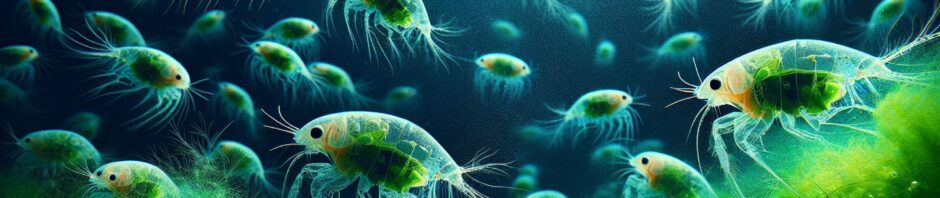
The world of aquatic ecosystems is complex and delicate, a symphony of interactions that support a wide variety of life forms. At the heart of these systems are small but mighty creatures that often go overlooked, despite their critical roles within aquatic environments. One such organism is Daphnia, a genus of small, planktonic crustaceans. Commonly known as water fleas, Daphnia play a crucial role in food webs, serve as indicators of water quality, and are a key species in ecotoxicological studies.
The Biology and Life Cycle of Daphnia
Daphnia are part of the class Cladocera and are prevalent in freshwater bodies, including ponds, lakes, and streams. They are a central element of the zooplankton community and a food source for many aquatic predators. Daphnia exhibit a fascinating reproductive strategy known as parthenogenesis, where females can produce offspring without the need for males. However, when environmental conditions deteriorate, they can switch to sexual reproduction to produce ephippia—protective cases that ensure the survival of their eggs through harsh conditions.
Life Cycle Stages
- Parthenogenetic Phase – Under favorable conditions, females reproduce asexually, leading to rapid population growth.
- Sexual Reproduction – Triggered by environmental cues such as diminishing food supply or changes in temperature, this leads to the production of ephippia.
- Ephippial Stage – Eggs within ephippia can resist adverse conditions and lay dormant, only hatching when conditions become suitable again.
The Ecological Significance of Daphnia
Role in Food Webs
Daphnia are filter feeders, consuming algae, bacteria, and other small particles suspended in water. As a result, they are a pivotal intermediary between primary producers and higher trophic levels. In other words, they are a main food source for predators such as fish, amphibians, and aquatic insects.
Influence on Algal Blooms
Because they feed heavily on algae, Daphnia can significantly influence the dynamics of algal blooms. They can keep algae populations in check and help prevent the harmful effects of eutrophication, which occurs when excessive nutrients lead to dense algal growth that depletes dissolved oxygen in water bodies.
Nutrient Cycling
Daphnia contribute to nutrient cycling within aquatic environments. They recycle nutrients through their excretion, which can then be utilized by primary producers, essentially serving as a vital component in the maintenance of ecosystem health.
Daphnia in Environmental Assessment and Ecotoxicology
Biomonitoring and Water Quality Indicators
Daphnia are highly sensitive to changes in water quality, making them excellent biomonitoring organisms. They respond rapidly to the presence of toxic substances, making them reliable water quality indicators.
Reasons for their use in biomonitoring:
- They are sensitive to various pollutants.
- Their short life cycles allow for quick assessment of effects.
- They are relatively easy to culture and maintain in laboratory settings.
Toxicity Testing
The sensitivity of Daphnia to chemical pollutants is not only useful for monitoring water quality but also for conducting toxicity tests. These tests assess the impact of chemicals on aquatic organisms and are an integral part of environmental protection regulations and frameworks.
Ecotoxicology Research
Studies on Daphnia have contributed to our understanding of how pollutants affect aquatic life at the molecular, individual, population, and community levels. Research on Daphnia helps in developing ecological risk assessments and management strategies for pollutants.
Daphnia and Global Challenges
Climate Change
Temperature effects are a significant concern with climate change. Daphnia populations may respond to increasing temperatures with altered distribution patterns, reproductive strategies, and availability as a food source for predators.
Anthropogenic Stressors
Anthropogenic activities introduce various stressors such as overfishing, habitat destruction, and pollution. Daphnia can serve as early warning systems signaling the onset of detrimental changes due to these human-induced factors.
Future Research and Conservation
Continued research on Daphnia can provide insights into evolutionary adaptations, population dynamics, and community interactions. These aspects are essential for creating effective conservation strategies to preserve aquatic biodiversity and ensure the sustainability of ecosystems where they serve a critical function.
Key Research Avenues
- Genomic Studies – Understanding the genetic basis of Daphnia‘s adaptation and response to environmental change.
- Long-term Monitoring – Tracking changes in Daphnia populations in relation to climate dynamics.
- Ecosystem Modeling – Incorporating Daphnia into food web models to predict impacts of environmental changes on aquatic ecosystems.
Conclusion
Daphnia are much more than microscopic freshwater crustaceans—they are invaluable for the health and functioning of aquatic ecosystems. They aid in maintaining water quality, understanding nutrient dynamics, and serve as a vital link in food webs. Their role in ecotoxicology and biomonitoring makes them indispensable for environmental assessments and for evaluating the impacts of human activities on aquatic life.
The importance of maintaining healthy Daphnia populations extends beyond ecological balance—it encompasses the well-being of entire freshwater ecosystems and the myriad of species that depend on them. Protecting these aquatic invertebrates is not just about conserving a single genus; it’s about safeguarding the intricate web of life that flourishes in our planet’s waters.
Sources
- Ebert, D. (2005). Ecology, Epidemiology, and Evolution of Parasitism in Daphnia. National Center for Biotechnology Information, U.S. National Library of Medicine. https://www.ncbi.nlm.nih.gov/books/NBK2042/
- Lampert, W. (2011). Daphnia: Model Herbivore, Predator and Prey. Poljoprivreda i Sumarstvo. http://www.pfos.hr/~poljo/upload/clanak/lampert-2011.pdf
- Colbourne, J. K., et al. (2011). The ecoresponsive genome of Daphnia pulex. Science, 331(6017), 555-561. https://science.sciencemag.org/content/331/6017/555
As water fleas continue to command the attention of scientists and ecologists, they remain a testament to the immense value of even the smallest organisms in preserving the intricate tapestry of life on Earth.