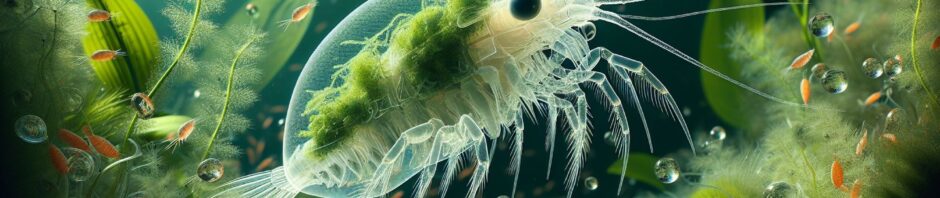
In the diverse and captivating world of aquatic ecosystems, one tiny organism stands out for its incredible survival abilities and its vital role within the food web: the Daphnia, commonly known as a ‘water flea’. Despite their microscopic size, these fascinating freshwater crustaceans play a significant part in maintaining a healthy aquatic environment.
What is a Daphnia?
Before diving into the role they play, let’s understand what exactly a Daphnia is. Daphnia is a genus of small, planktonic crustaceans, usually 1-5mm in size. They belong to the family Daphniidae and the order Cladocera[^1^]. They are among the several small aquatic crustaceans commonly termed as ‘water fleas’ due to their jerk-like swimming style.
Daphnia’s Life Cycle and Reproduction
Daphnia has an interesting and complex life cycle. They reproduce through a form of asexual reproduction known as parthenogenesis, in which females produce offspring without the aid of male fertilization. For the majority of the year, the population consists almost entirely of females, yet when conditions become unfavorable or stressful, males are produced, and sexual reproduction can occur[^2^].
In the sexual phase of reproduction, females produce a resting egg-case, known as an ephippia. This ephippium ensures survival during winter months, when food supplies are limited, or in drought conditions. The eggs within the ephippia can resist drought, cold, and a lack of food, and can hatch when conditions return to being favorable[^1^].
The Role of Daphnia in Aquatic Ecosystems
As primary consumers in the food web, Daphnia play an essential role in aquatic ecosystems. They serve as a bridge between primary producers (algae and other microscopic plants) and higher trophic levels, including fish and other invertebrates. Daphnia feed primarily on algae (making them wonderful filter feeders), but they can also consume bacteria, detritus, and other particulate material[^2^].
Their vital role in nutrient cycling can also aid in controlling algal blooms, which can be detrimental to aquatic environments, thus controlling eutrophication indirectly. Their feeding habits keep algal populations in check, preventing the buildup of excess nutrients in the water[^3^].
Daphnia as Biological Indicators
Another remarkable feature of Daphnia is their use in ecotoxicology as indicators of water quality and for toxicity testing. These organisms are extremely sensitive to changes in water quality, including temperature shifts, changes in dissolved oxygen levels, and the presence of various chemical pollutants[^2^].
Daphnia’s easy cultivation, rapid reproduction, and sensitivity to environmental changes make them perfect candidates for bioassays in the field of biomonitoring. This field is vital as it keeps check on environmental health and warns about toxic conditions in an ecosystem[^4^].
Survival Against Predators
Daphnia display outstanding survival capabilities whenever they are faced with predators. Changes in predator presence have been known to trigger both behavioral responses and morphological changes in Daphnia populations, contributing to their reputation as adaptable and resilient organisms. These adaptations can range from migrating to deeper water during the day to avoid visually hunting predators, to growing larger spines to prevent predator ingestion[^5^].
The Wonder of Daphnia
From their unique reproduction methods to their indispensable role within aquatic environments, Daphnia is a truly astonishing organism. Their existence balances the ecosystem and allows it to function smoothly. Despite being one of the smallest creatures in the water bodies, their contribution to nature is mammoth. With ongoing research in the field of environmental assessment and ecotoxicology, the importance of Daphnia as bioindicators cannot be overstated.
In essence, Daphnia serve as tiny protectors of aquatic health, ensuring balance within their domain, and showcasing the immense complexity and wonder to be found within even the smallest of Earth’s creatures.
References
[^1^]: “Daphnia: An Aquatic Model System for Ecology, Evolution and Ecotoxicology” by Linda C. Weiss, et al. Nature, 2020. source
[^2^]: “Using Daphnia for Teaching and Research” by Michael A. Wyngaard. Journal of Biological Education, 2010. source
[^3^]: “Daphnia ecology, genetics and environmental change: a review” by A. J. Tessier and L. J. Weider. Freshwater Biology, 2004. source
[^4^]: “Daphnia as an Emerging Epigenetic Model Organism” by John K. Colbourne, et al. Genetics Research International, 2011. source
[^5^]: “Predator-Induced Plasticity in the Life History of Daphnia pulex” by Kurt A. Gustafsson, et al. Ecology, 2005. source